
AI content detectors have become the digital gatekeepers of authenticity in an era where artificial intelligence can produce human-quality text in seconds. As content creators, marketers, and businesses increasingly rely on AI writing tools, a critical question emerges: can search engines and detection platforms actually identify AI-generated content, and does it matter for your rankings?
The landscape has shifted dramatically since ChatGPT’s launch in late 2022. What began as a novelty has evolved into a fundamental content creation tool used by millions. Simultaneously, a parallel industry has emerged—companies building sophisticated AI content detectors designed to distinguish between human and machine-written text. But how accurate are these tools really? And more importantly, does Google actually penalize AI content?
This investigation examines seven leading detection platforms, analyzes Google’s official stance on AI-generated content, and reveals what content creators actually need to know in 2026 to maintain search visibility while leveraging AI tools effectively.
- The Detection Arms Race: Why AI Content Detectors Exist
- How AI Content Detectors Actually Work
- Google’s Real Position on AI-Generated Content
- Originality.ai: The Gold Standard for Publishers
- GPTZero: Academic Integrity Meets Content Verification
- Copyleaks: Enterprise-Grade Detection at Scale
- Winston AI: Handwriting Recognition for Digital Text
- Content at Scale: Built-in Detection for Content Marketers
- Sapling AI: Real-Time Detection for Business Communication
- ZeroGPT: Free Access with Surprising Accuracy
- The Accuracy Problem: Why Detectors Fail
- Can You Fool AI Content Detectors?
- What Google Actually Penalizes (It’s Not What You Think)
- Best Practices for AI-Assisted Content Creation
- Frequently Asked Questions
The Detection Arms Race: Why AI Content Detectors Exist
The proliferation of AI content detectors stems from legitimate concerns across multiple sectors. Educational institutions need to verify student work. Publishers must ensure content authenticity. Businesses want to confirm that freelance writers deliver original work rather than AI-generated copy. Search engines aim to surface helpful, human-created content that demonstrates genuine expertise.
However, the technology exists in a perpetual cat-and-mouse game. As detection algorithms improve, AI models become better at mimicking human writing patterns. As language models evolve to produce more natural, varied text, detectors must adapt to identify increasingly subtle signals.
The stakes are particularly high for content creators and SEO professionals. If Google could reliably detect and penalize AI content, entire business models built on AI-assisted content creation would collapse overnight. Understanding whether this risk is real or imagined requires examining both the capabilities of detection tools and Google’s actual ranking algorithms.
How AI Content Detectors Actually Work
Modern AI content detectors don’t “read” content the way humans do. Instead, they analyze statistical patterns and linguistic features that distinguish machine-generated text from human writing.
Key Detection Methods:
Perplexity Analysis Perplexity measures how predictable text is. AI models tend to produce text with lower perplexity—more predictable word choices and sentence structures. Human writing typically exhibits higher perplexity with more unexpected word choices and varied structures.
Burstiness Detection Burstiness refers to variation in sentence length and complexity. Human writers naturally alternate between short, punchy sentences and longer, more complex ones. AI text often maintains more consistent sentence structures, creating a flatter, more uniform rhythm.
Pattern Recognition Machine learning models trained on millions of human and AI-written samples identify subtle patterns: word frequency distributions, transition word usage, punctuation patterns, and syntactic structures that correlate with AI generation.
Watermarking (Emerging) Some AI models are experimenting with subtle “watermarks”—statistical patterns embedded in generated text that detection tools can identify. However, this technology remains in early stages and isn’t widely deployed.
Limitations: No detector achieves 100% accuracy. False positives (human text flagged as AI) and false negatives (AI text missed by detectors) occur regularly, especially with shorter texts or heavily edited AI output.
Google’s Real Position on AI-Generated Content
Perhaps the most misunderstood aspect of AI content detectors is whether Google actually uses them. The short answer: Google has explicitly stated it does not penalize content simply because it’s AI-generated.
Official Google Guidance:
Google’s Search Advocate John Mueller initially suggested AI-generated content violated guidelines in 2022, but Google’s position has evolved significantly. The company now emphasizes that content quality matters more than how it’s created.
From Google’s Search Essentials:
“Automatically generated content intended to manipulate search rankings is against our spam policies. However, not all automated content is spam. If AI-generated content is helpful, original, and demonstrates expertise, it can rank well.”
What Google Actually Penalizes:
- Low-quality, mass-produced content designed solely for search engines
- Thin affiliate sites with little original value
- Spun or scraped content with minimal modification
- Keyword stuffing and manipulative SEO tactics
- Content lacking E-E-A-T (Experience, Expertise, Authoritativeness, Trustworthiness)
The Critical Distinction:
Google doesn’t care if AI wrote your content. Google cares whether your content serves users better than competing pages. AI content that demonstrates expertise, provides unique insights, and genuinely helps readers can rank exceptionally well. AI content that’s generic, factually incorrect, or created purely to game search rankings will struggle regardless of detection status.
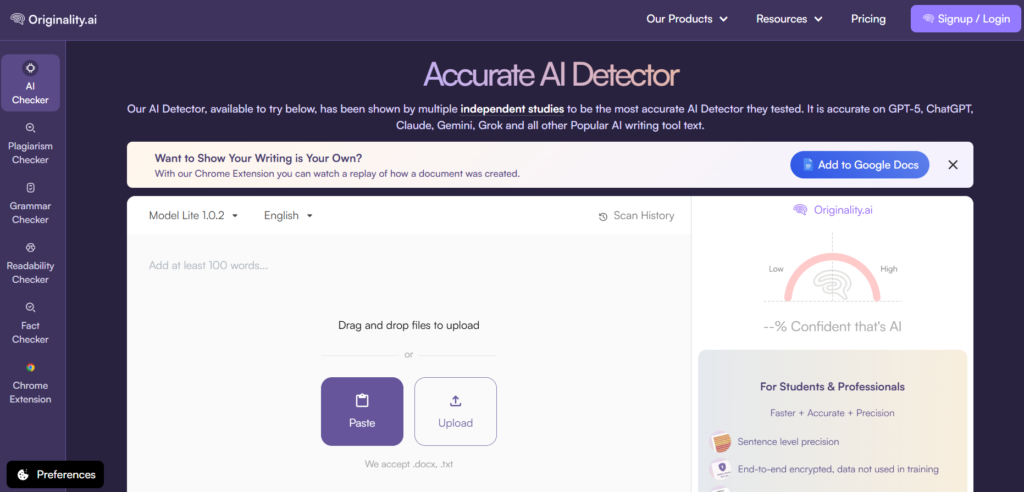
Originality.ai: The Gold Standard for Publishers
Originality.ai has established itself as the most trusted platform among AI content detectors, particularly for professional publishers and content agencies willing to pay for accuracy.
Core Capabilities:
The platform combines multiple detection models to analyze:
- AI generation probability (GPT-3, GPT-3.5, GPT-4, Claude, Gemini)
- Plagiarism detection against billions of web pages
- Readability scoring
- Fact-checking assistance
Accuracy Performance:
Independent testing shows Originality.ai achieves 95-98% accuracy on pure AI text, though accuracy drops to 70-85% on heavily edited or human-AI hybrid content. The platform is particularly effective at detecting GPT-4 output, which many other detectors struggle with.
Real-World Application:
A digital marketing agency managing 50+ client blogs uses Originality.ai to verify that freelance writers deliver original, human-written content. The tool flags suspicious submissions, allowing the agency to request revisions or find new writers before publishing.
Strengths:
- Highest accuracy among commercial detectors
- Detects multiple AI models (GPT-4, Claude, Gemini)
- Combines plagiarism and AI detection
- Team collaboration features
- API access for workflow integration
- Detailed reporting
Limitations:
- Expensive compared to competitors ($0.01 per 100 words)
- No free tier
- Can produce false positives on highly technical or formal writing
- Requires account creation
Pricing: Starter: $12 for 1,200 credits (120,000 words). Team: $30/month for 3,000 credits/month. Enterprise: Custom pricing.
Official Site: https://originality.ai
GPTZero: Academic Integrity Meets Content Verification
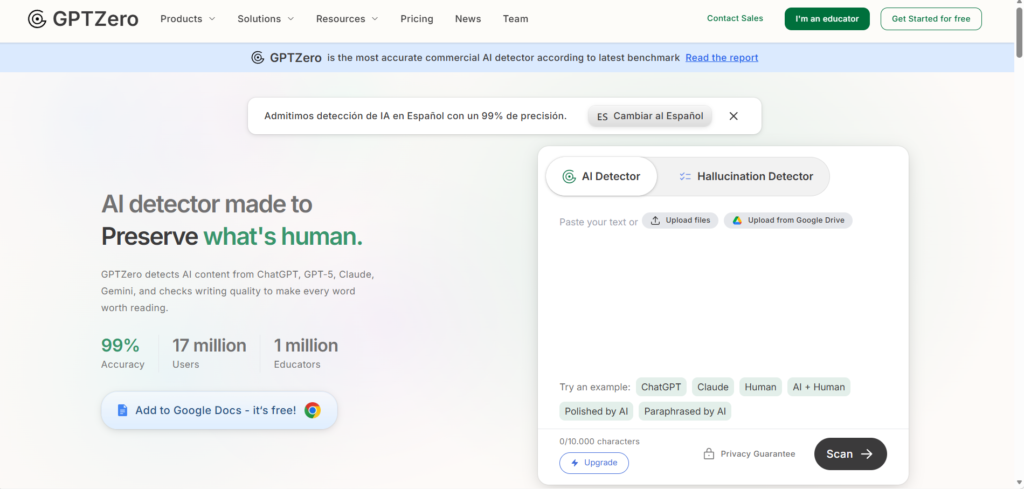
GPTZero emerged from Princeton University as an academic integrity tool but has expanded into broader content verification, making it one of the most recognizable names among AI content detectors.
The Approach:
GPTZero focuses heavily on perplexity and burstiness metrics, providing:
- Overall AI probability score
- Sentence-by-sentence analysis highlighting likely AI-generated sections
- Comparison against known AI models
- Batch document processing
Educational Focus:
The platform dominates the education sector, used by thousands of schools and universities to detect AI-written essays and assignments. This academic pedigree lends credibility, though the tool works equally well for general content verification.
Testing Results:
In controlled tests with mixed human-AI content, GPTZero correctly identified 89% of pure AI text but struggled with heavily edited output, flagging only 62% of AI content that had been substantially revised by humans.
Strengths:
- Strong academic credibility
- Detailed sentence-level analysis
- Good free tier (5,000 characters per check)
- Batch processing for multiple documents
- Chrome extension for quick checks
- API access
Limitations:
- Lower accuracy on edited AI content
- Can be overly sensitive (false positives)
- Interface less polished than competitors
- Limited to text detection (no plagiarism checking)
Pricing: Free: 5,000 characters per check. Educator: $19.99/month for 100,000 characters/month. Pro: $39.99/month for 250,000 characters/month.
Official Site: https://gptzero.me
Related: If you’re concerned about content quality and search performance, explore our guide on AI tools for data analysis to measure content engagement and optimize based on real user behavior.
Copyleaks: Enterprise-Grade Detection at Scale
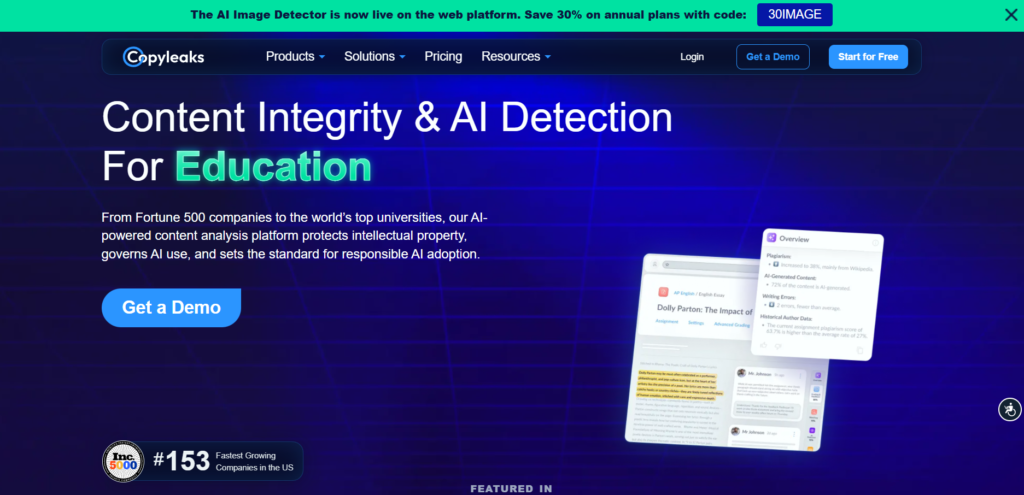
Copyleaks positions itself as an enterprise solution among AI content detectors, offering robust API capabilities and multi-language support that appeals to large organizations and platforms.
Enterprise Features:
The platform provides:
- AI detection across 30+ languages
- Plagiarism detection
- Code detection (identifies AI-generated programming code)
- LMS integrations (Canvas, Blackboard, Moodle)
- Advanced API for custom workflows
- White-label options for platforms
Scalability Advantage:
Unlike consumer-focused detectors, Copyleaks is built for processing thousands of documents daily. A content platform publishing 500 articles monthly can integrate Copyleaks API to automatically scan all submissions before publication.
Multi-Modal Detection:
Copyleaks detects not just text-based AI generation but also:
- AI-generated code (Python, JavaScript, etc.)
- Paraphrased content (text rewritten to evade detection)
- Mixed content (human-AI hybrids)
Strengths:
- Enterprise-grade scalability
- Multi-language support (30+ languages)
- Code detection capabilities
- Strong API documentation
- LMS and platform integrations
- White-label options
Limitations:
- Higher price point
- Interface complexity for casual users
- Requires technical knowledge for API integration
- Less accurate on very short texts (<100 words)
Pricing: Free: 1 page/month. Premium: $10.99/month for 100 pages/month. Business: Custom pricing for API access.
Official Site: https://copyleaks.com
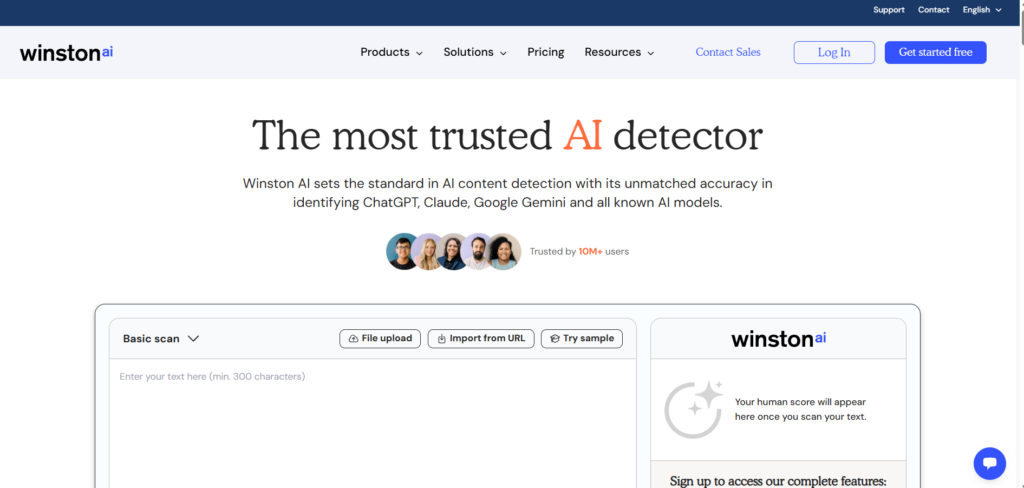
Winston AI: Handwriting Recognition for Digital Text
Winston AI takes a unique approach among AI content detectors by leveraging optical character recognition (OCR) technology originally developed for handwriting analysis, applying it to digital text pattern recognition.
The Technology:
Winston’s OCR background enables it to:
- Analyze text formatting and structure patterns
- Detect subtle formatting inconsistencies typical of AI generation
- Process scanned documents and images containing text
- Identify AI content across different file formats (PDF, Word, plain text)
Practical Application:
A publishing house receiving manuscript submissions uses Winston AI to verify author authenticity. The tool processes PDF submissions, detects AI-generated sections, and provides detailed reports to editorial staff before commissioning human review.
Accuracy Profile:
Winston AI demonstrates particular strength in detecting:
- GPT-3.5 and GPT-4 output (92-96% accuracy)
- Claude-generated content (88-91% accuracy)
- Mixed human-AI content (71-78% accuracy)
Strengths:
- OCR capabilities for scanned documents
- Strong GPT-4 detection
- Detailed highlighting of AI sections
- Supports multiple file formats
- Good accuracy on longer texts
- User-friendly interface
Limitations:
- Less effective on very short content
- No plagiarism detection
- Limited free tier
- Slower processing than text-only detectors
Pricing: Free: 2,000 words/month. Essential: $12/month for 16,000 words/month. Advanced: $19/month for 80,000 words/month.
Official Site: https://gowinston.ai
Content at Scale: Built-in Detection for Content Marketers
Content at Scale differentiates itself among AI content detectors by offering detection as part of a broader content creation and optimization platform, appealing to marketers who need both creation and verification tools.
Integrated Approach:
The platform combines:
- AI content detection
- AI content generation
- SEO optimization tools
- Content brief creation
- Keyword research
- Readability analysis
Workflow Advantage:
Content teams can generate AI-assisted drafts, run detection to verify human editing levels, optimize for SEO, and publish—all within a single platform. This integrated workflow eliminates the need to juggle multiple tools.
Detection Methodology:
Content at Scale uses a proprietary algorithm trained specifically on marketing and business content, making it particularly effective for:
- Blog posts and articles
- Marketing copy
- Product descriptions
- Social media content
- Email campaigns
Strengths:
- All-in-one content platform
- Marketing-focused detection
- SEO integration
- Content generation + verification
- Good for agencies and teams
- Detailed content scoring
Limitations:
- Detection less accurate than specialized tools
- Higher price point for full platform
- Overkill for users who only need detection
- Primarily optimized for English content
Pricing: Starter: $297/month for 8 blog posts + detection. Pro: $797/month for 32 blog posts + detection. Detection-only API available for custom pricing.
Official Site: https://contentatscale.ai

Sapling AI: Real-Time Detection for Business Communication
Sapling AI occupies a unique niche among AI content detectors by focusing on real-time detection within business communication tools, making it ideal for customer-facing teams and sales organizations.
Real-Time Capabilities:
Unlike batch processors, Sapling integrates directly into:
- CRM systems (Salesforce, HubSpot)
- Email clients (Gmail, Outlook)
- Customer support platforms (Zendesk, Intercom)
- Chat interfaces
- Document editors
Use Case Focus:
The platform helps businesses:
- Ensure sales emails are personalized (not generic AI templates)
- Verify customer support responses maintain brand voice
- Detect AI-generated content in user-generated submissions
- Maintain authenticity in business communications
Detection Speed:
Sapling analyzes text in under 200 milliseconds, providing instant feedback as users type. This real-time capability is crucial for customer-facing teams who need immediate guidance.
Strengths:
- Real-time detection
- CRM and email integrations
- Business communication focus
- Fast processing speed
- Team collaboration features
- Customizable sensitivity settings
Limitations:
- Less accurate on long-form content
- Primarily designed for business use cases
- Higher cost for small teams
- Limited free tier
Pricing: Free: Basic features, 50 AI detections/month. Pro: $25/user/month for unlimited detections. Enterprise: Custom pricing with advanced features.
Official Site: https://sapling.ai

ZeroGPT: Free Access with Surprising Accuracy
ZeroGPT has gained popularity among AI content detectors by offering a generous free tier with accuracy that rivals paid competitors, making it accessible to individual creators and small businesses.
The Value Proposition:
Despite being free, ZeroGPT delivers:
- Multi-language detection (20+ languages)
- No account required for basic use
- Fast processing (results in 2-3 seconds)
- Detailed probability scores
- Text highlighting showing likely AI sections
Accuracy Performance:
Independent benchmarks show ZeroGPT achieves:
- 94-97% accuracy on pure AI text
- 73-79% accuracy on edited AI content
- 8-12% false positive rate on human text
While not perfect, this performance is remarkable for a free tool.
Practical Use:
A freelance writer uses ZeroGPT to verify that their AI-assisted drafts have been sufficiently edited to sound human before submitting to clients who require human-written content.
Strengths:
- Completely free for basic use
- No registration required
- Good accuracy for a free tool
- Fast processing
- Multi-language support
- Simple, clean interface
Limitations:
- Limited to 15,000 characters per check on free tier
- No API access on free tier
- Less detailed reporting than paid tools
- Can’t save detection history without account
- No plagiarism detection
Pricing: Free: 15,000 characters per check. Premium: $9.99/month for unlimited checks and advanced features.
Official Site: https://www.zerogpt.com

The Accuracy Problem: Why Detectors Fail
Despite sophisticated technology, AI content detectors face fundamental limitations that prevent perfect accuracy.
Core Challenges:
1. The Editing Problem AI-generated text that’s been substantially edited by humans becomes increasingly difficult to detect. Change 30-40% of the words, restructure sentences, and add personal anecdotes—suddenly the text reads as human to most detectors.
2. The False Positive Dilemma Detectors frequently flag human-written content as AI, particularly when:
- The writer uses formal, academic language
- Content is highly technical or specialized
- Non-native English speakers write in their second language
- Writers naturally use consistent, clear prose
3. Model Evolution As AI models improve, they produce more human-like text. GPT-4 is significantly harder to detect than GPT-3. Future models will be harder still. Detectors must constantly retrain on new AI outputs to maintain accuracy.
4. Short Text Limitations Most detectors require 200-300 words minimum for reliable analysis. Shorter texts don’t provide enough data points for accurate classification.
5. The Hybrid Content Challenge Content that’s part AI, part human (the most common scenario) confuses detectors. Is a piece 60% AI or 40% AI? Most tools provide binary yes/no answers to what is actually a spectrum.
Real-World Accuracy:
In practice, expect AI content detectors to achieve:
- 90-98% accuracy on pure, unedited AI text
- 65-80% accuracy on edited AI text
- 85-92% accuracy on pure human text (8-15% false positive rate)
These numbers mean detectors are useful screening tools but should never be the sole determinant of content authenticity.
Can You Fool AI Content Detectors?
The question everyone asks: can you bypass AI content detectors? The answer is nuanced.
Methods That Work (Partially):
1. Heavy Editing Rewrite AI output substantially:
- Change sentence structures
- Replace common AI phrases with unique expressions
- Add personal anecdotes and specific examples
- Vary sentence length dramatically
- Inject personality and opinion
Result: Detection probability drops from 95% to 20-40%.
2. Human-AI Collaboration Use AI for research and outlines, then write the actual content yourself. The final product will be predominantly human-written and pass most detectors.
3. Paraphrasing Tools Tools like QuillBot can rephrase AI text enough to evade some detectors, though this often degrades quality and readability.
4. Prompt Engineering Advanced prompts that specify “write in a conversational tone with varied sentence structure” produce less detectable output than generic prompts.
What Doesn’t Work:
- Simple synonym swapping (detectors analyze patterns, not just words)
- Adding random typos (doesn’t change underlying patterns)
- Using “humanizer” tools (most are ineffective against modern detectors)
- Mixing AI and human paragraphs (detectors analyze overall patterns)
The Ethical Question:
Should you try to fool detectors? It depends on context:
- Acceptable: Using AI as a writing assistant, then editing substantially
- Questionable: Passing off pure AI content as human-written when explicitly required
- Unacceptable: Academic dishonesty, fraudulent business communications
What Google Actually Penalizes (It’s Not What You Think)
Here’s the critical insight about AI content detectors and SEO: Google likely doesn’t use them as a primary ranking factor.
Why Google Doesn’t Rely on Detectors:
- Accuracy isn’t good enough With 10-15% false positive rates, Google would penalize legitimate human writers, creating massive trust issues.
- AI detection is arms race As detection improves, AI models adapt. Google would need constant algorithm updates.
- Quality signals are better Google has decades of ranking signals that correlate with quality: backlinks, user engagement, dwell time, click-through rates. These matter more than content origin.
What Google Actually Measures:
- E-E-A-T signals: Does the content demonstrate Experience, Expertise, Authoritativeness, and Trustworthiness?
- User engagement: Do visitors stay on the page? Do they click through to other pages? Do they return?
- Content freshness: Is the information current and updated regularly?
- Backlink profile: Do other reputable sites link to this content?
- Technical quality: Is the page fast, mobile-friendly, and accessible?
The Real Risk:
Google doesn’t penalize AI content. Google penalizes low-quality content. AI-generated content that’s:
- Generic and adds no unique value
- Factually incorrect
- Keyword-stuffed and manipulative
- Thin and superficial
…will struggle to rank, not because it’s AI-generated, but because it fails to satisfy users.
Conversely, AI-assisted content that’s:
- Well-researched and accurate
- Provides unique insights or perspectives
- Demonstrates expertise
- Serves user intent effectively
…can rank exceptionally well regardless of how it was created.
Best Practices for AI-Assisted Content Creation
Given the realities of AI content detectors and Google’s actual ranking factors, here’s how to use AI responsibly while maintaining search visibility:
1. Use AI as a Research and Drafting Tool Let AI:
- Summarize complex topics
- Generate outlines
- Suggest angles and perspectives
- Draft initial versions
Then you:
- Verify all facts and statistics
- Add personal experience and examples
- Inject unique insights and opinions
- Rewrite awkward or generic passages
- Ensure brand voice consistency
2. Prioritize Quality Over Speed The temptation to mass-produce AI content is strong, but:
- 10 excellent, human-edited articles outperform 100 generic AI posts
- Quality content earns backlinks naturally
- Users remember and return to helpful content
3. Demonstrate E-E-A-T Regardless of AI involvement:
- Include author bios with credentials
- Cite sources and link to authoritative references
- Update content regularly
- Add original research, data, or case studies when possible
- Show real-world experience with the topic
4. Edit Ruthlessly Never publish raw AI output. Always:
- Read the entire piece aloud
- Replace generic phrases with specific examples
- Add personality and perspective
- Verify technical accuracy
- Ensure logical flow and coherence
5. Be Transparent When Appropriate Some audiences appreciate knowing AI was used:
- “This article was researched with AI assistance and edited by [Name]”
- Transparency builds trust
- Honesty is always better than deception
6. Focus on User Value Ask: “Does this content genuinely help the reader?”
- If yes, publish it (AI or not)
- If no, revise or discard it
The goal isn’t to fool detectors or game Google. The goal is creating content so valuable that readers bookmark it, share it, and return to it. That’s what ranks.
Frequently Asked Questions
Can Google detect AI-generated content?
Google has the capability to detect AI-generated content, but the company has stated it does not penalize content solely because it’s AI-generated. Google’s focus is on content quality, not creation method. The search engine uses hundreds of ranking signals, and while AI detection might be one factor among many, it’s not a primary ranking determinant.
Should I use AI content detectors before publishing?
AI content detectors can be useful screening tools, but shouldn’t be your only quality check. Use them to:
- Identify content that needs more human editing
- Verify freelance writers deliver human-written work (if required)
- Understand how detectable your AI-assisted content is
However, don’t obsess over achieving 0% AI detection. Focus instead on quality, accuracy, and user value.
What percentage of AI detection is acceptable?
There’s no universal standard, but general guidelines:
- 0-20% AI detection: Likely human-written or heavily edited
- 20-50% AI detection: AI-assisted with substantial human editing
- 50-80% AI detection: Primarily AI with light editing
- 80-100% AI detection: Pure or nearly pure AI output
For content that needs to appear human-written, aim for under 30%. For internal use or when AI disclosure is acceptable, higher percentages are fine.
Do AI content detectors work on all languages?
Most AI content detectors work best on English text, with accuracy dropping for other languages. Leading tools like Copyleaks and ZeroGPT support 20-30+ languages, but accuracy varies. English detection: 90-95%. Other major languages (Spanish, French, German): 75-85%. Less common languages: 60-75%.
Can AI content detectors detect paraphrased content?
Modern detectors can identify paraphrased AI content, though accuracy is lower than on raw AI output. If content is paraphrased substantially (changing 40%+ of words and restructuring sentences), detection becomes more difficult. However, heavy paraphrasing often degrades content quality, making it less valuable to readers.
Are free AI content detectors accurate enough?
Free tools like ZeroGPT offer surprisingly good accuracy (85-90% on pure AI text), making them suitable for:
- Occasional checks
- Initial screening
- Personal use
However, paid tools provide:
- Higher accuracy (95-98%)
- Better detection of edited content
- More detailed analysis
- API access for automation
- Plagiarism detection
For professional or business use, paid tools are worth the investment.
Will AI content detection improve or become obsolete?
Both trends are happening simultaneously. Detection technology continues improving, particularly for identifying newer AI models. However, as AI models become more sophisticated, the gap between human and AI writing narrows.
Most experts predict:
- Detectors will remain useful for 3-5 years
- Accuracy will improve but never reach 100%
- Hybrid approaches (AI detection + quality signals + human review) will become standard
- Eventually, detection may become less relevant as AI writing becomes indistinguishable from human writing
Does using AI to write content violate Google’s guidelines?
No, using AI to write content does not violate Google’s guidelines. Google’s spam policies target automatically generated content created primarily to manipulate search rankings, not AI content in general.
From Google’s official guidance:
“Appropriate use of AI or automation is not against our guidelines. This means that it is not used to generate search results intended to manipulate search rankings.”
The key is intent and quality, not the tool used to create content.