
Building an AI agency in 2026 no longer relies on selling vague automation promises. The market has matured. Clients do not want decorative chatbots or empty dashboards. They want measurable outcomes: reduced operational costs, faster sales cycles, and systems that run without constant supervision.
If you are considering entering this space, timing matters. Demand currently outpaces the supply of teams that actually know how to implement, integrate, and maintain AI solutions in live business environments. The barrier to entry has shifted. Knowing how to prompt a model is no longer enough. You need business architecture, delivery processes, and a value proposition that solves concrete operational friction.
This guide avoids surface-level advice. It outlines how to structure a profitable operation from day one, bypass the mistakes that shut down agencies within six months, and build a model that scales without chaining you to client management.
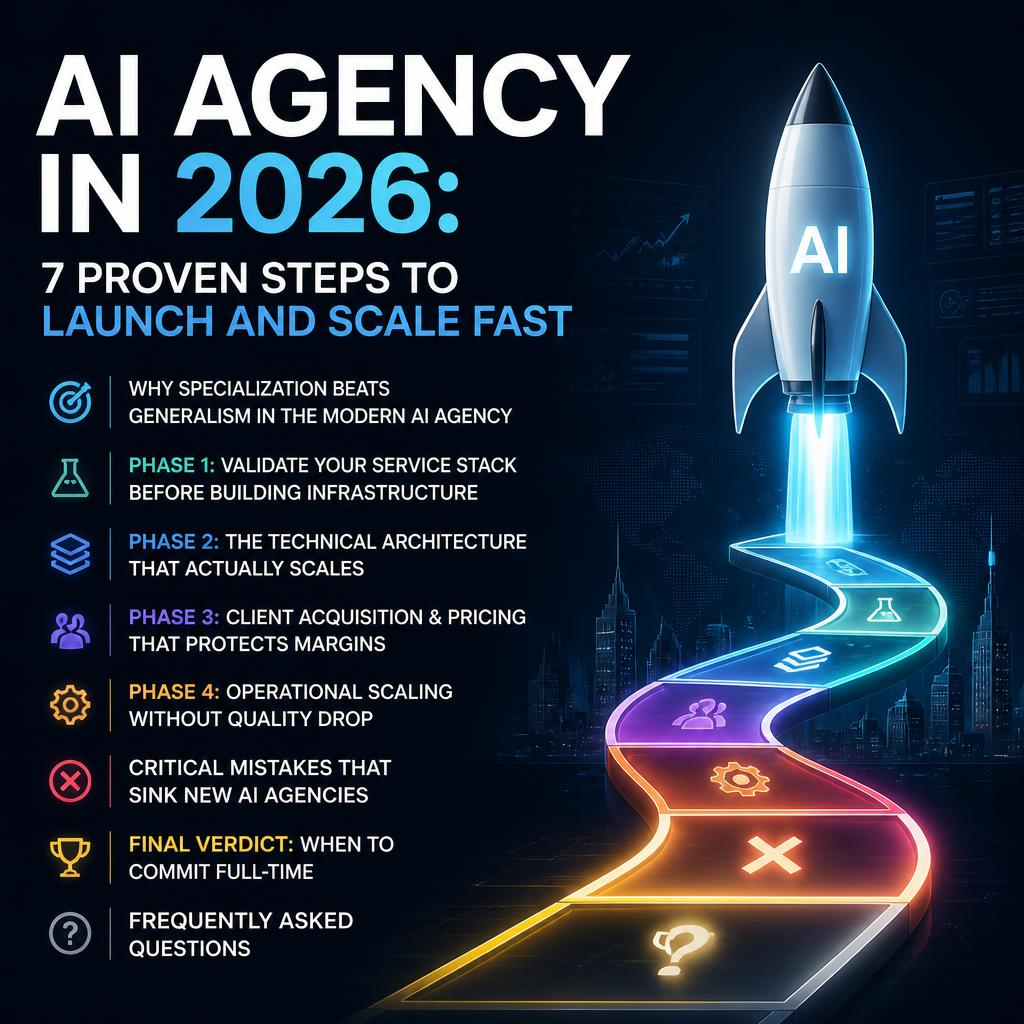
- Why Specialization Beats Generalism in the Modern AI Agency
- Phase 1: Validate Your Service Stack Before Building Infrastructure
- Phase 2: The Technical Architecture That Actually Scales
- Phase 3: Client Acquisition & Pricing That Protects Margins
- Phase 4: Operational Scaling Without Quality Drop
- Critical Mistakes That Sink New AI Agencies
- Final Verdict: When to Commit Full-Time
- Frequently Asked Questions
Why Specialization Beats Generalism in the Modern AI Agency
The era of “we do everything with AI” ended in 2024. Companies that survive and grow are those solving a specific problem for a defined sector. A successful AI agency does not sell technology. It sells operational results.
A logistics manufacturer does not need “automation.” It needs to cut warehouse sorting time by 30%. A dental clinic does not want “smart assistants.” It wants to reduce missed appointments by 25% through intelligent reminders and automated rescheduling.
Specialization enables you to:
- Create repeatable case studies
- Shorten implementation timelines
- Command premium rates for vertical expertise
- Minimize the learning curve per project
Pick a niche where the pain is obvious, budgets exist, and technical competition remains thin. Healthcare operations, B2B e-commerce, professional services, and light manufacturing show accelerated adoption with low provider saturation
Phase 1: Validate Your Service Stack Before Building Infrastructure
Many founders purchase domains, design logos, and launch websites before securing a single paying client. Validation must come first.
Design three tiered service packages:
1. Process Audit with AI Mapping Deliverable: Current workflow analysis, bottleneck identification, implementation roadmap with estimated ROI. Timeline: 1-2 weeks. Price: $900-$1,600. Goal: Serve as the entry point to larger engagements.
2. Automated Flow Implementation Deliverable: Live system deployment (e.g., lead capture + nurturing + calendar booking + follow-up sequences). Timeline: 3-4 weeks. Price: $2,800-$5,500 + monthly maintenance. Goal: Generate tangible results and build positive dependency.
3. Continuous Management & Optimization Deliverable: Monitoring, prompt adjustments, new tool integrations, monthly performance reports. Timeline: Recurring. Price: $900-$2,200/month. Goal: Financial stability and predictable scaling.
Validate these packages with 3-5 beta clients. Offer an introductory discount in exchange for detailed testimonials and permission to publish real metrics. If you fail to close at least two out of five proposals, refine the offer before investing in fixed overhead.
Phase 2: The Technical Architecture That Actually Scales
Your technology stack should not be the most expensive. It must be the most interoperable. Tool fragmentation is the primary cause of delivery delays and budget overruns in live projects.
Orchestration Layer: Select a central platform that connects APIs, manages workflows, and allows version control. n8n, Make, or Zapier work, but prioritize n8n if you require complex logic and self-hosting. Avoid closed ecosystems that restrict data export.
Language Model Layer: Do not lock yourself to a single provider. Maintain compatibility with OpenAI, Anthropic, and open-source local models (Llama, Mistral) for privacy-sensitive or cost-variable use cases. Implement a prompt router that selects the model based on complexity and client budget.
Data & Memory Layer: AI systems without historical context fail quickly. Deploy vector databases (Pinecone, Weaviate) for long-term memory. Clients value agents that “remember” preferences, interaction history, and past decisions.
Deployment & Monitoring Layer: Use Docker containers or serverless functions to guarantee on-demand scaling. Implement detailed logging and failure alerts. A system that breaks silently destroys trust faster than a visible error.
The golden rule: every component must be replaceable without rewriting core logic. The AI agency that survives API changes and model updates is the one designed with abstraction, not rigid coupling.
Phase 3: Client Acquisition and Pricing That Protects Margins
Acquiring clients does not require mass advertising. It requires authority positioning and a sales process that educates while filtering.
Entry Strategy:
- Publish case studies with real metrics (hours saved, cost reduced, conversion improved)
- Host technical webinars for operations directors, not “AI enthusiasts”
- Participate in industry forums answering specific questions, not pitching services
Pricing Structure: Avoid hourly billing. It destroys profitability and turns you into an invoiced employee. Use:
- Fixed project pricing with defined scope
- Monthly retainer with clear SLA
- Hybrid model: fixed implementation + percentage of generated savings
Closing Process:
- Free 30-minute diagnostic to identify the actual pain point
- Proposal with three options (basic, recommended, premium)
- Contract with payment milestones and scope clauses
- Structured onboarding (access provisioning, expectation alignment, contact points)
Scope transparency matters more than outcome promises. Document exactly what is included and what falls outside. Misunderstandings during delivery are the leading cause of non-payment and disputes.
Phase 4: Operational Scaling Without Quality Drop
Growth does not mean hiring more people. It means systematizing before expanding.
Living Documentation: Create playbooks per project type. Not static manuals. Versioned guides with screenshots, base prompts, API configurations, and frequent error resolutions. Every new delivery should update the playbook.
Strategic Hiring: Do not hunt for “AI experts.” Seek hybrid profiles: developers with business vision, experience designers who understand workflows, project managers who master integrations. Technical skills can be taught. Systemic thinking is rarer.
Quality Control: Implement cross-reviews before delivery. A second pair of eyes catches logic flaws, ambiguous prompts, or unstable integrations. Perceived quality depends on consistency, not complexity.
Expectation Management: Communicate technical limits from day one. AI does not fix poorly designed processes. It does not replace commercial strategy. It does not substitute human judgment in critical decisions. Anyone promising otherwise signs their own technical dismissal.
1. Underestimating Post-Implementation Maintenance AI systems require continuous tuning. Data shifts, behaviors evolve, APIs update. Charge for maintenance or structure retainers from day one.
2. Overengineering During Validation Do not build an enterprise platform for a workflow solvable with three connected tools. Simplicity beats complexity until volume demands otherwise.
3. Ignoring Client Training A brilliant system that the client’s team cannot use is an expense, not an investment. Include onboarding sessions, quick-reference guides, and documented initial support.
4. Relying on a Single Acquisition Channel If 100% of your clients come from one platform or referrer, your business is fragile. Diversify: referrals, technical content, partnerships with traditional consultancies, industry events.
5. Confusing Volume With Profitability Three clients at $2,000/month managed well generate more profit and less stress than ten at $500/month with undefined scope. Prioritize margin over revenue.
Final Verdict: When to Commit Full-Time
Launching an AI agency in 2026 does not require massive initial capital. It requires offer clarity, operational discipline, and patience to build technical authority.
If you can solve a specific problem, document your process, charge for value, and maintain quality under pressure, the model is viable and highly scalable. If you seek technical shortcuts or magical promises, the market will correct you quickly.
Technology is a multiplier. Strategy is the foundation. Build the foundation first. The multiplier handles the rest.
Frequently Asked Questions
Do I need to be a programmer to start an AI agency?
No. You need sufficient technical understanding to evaluate feasibility, coordinate integrations, and communicate limits to clients. You can partner with a developer or use low-code/no-code platforms for standard workflows. Sales and project management are usually the real bottlenecks, not coding.
How long until an AI agency becomes profitable?
With a validated model and two recurring clients, most agencies reach break-even between month two and four. Sustained profitability arrives when monthly retainers cover fixed costs and leave room for reinvestment or profit distribution.
Can a small agency compete with large consulting firms?
Yes, through specialization. Large firms sell generic digital transformation. You can offer rapid implementation, continuous support, and sector adaptation. Mid-market clients prefer agility and direct communication over corporate branding.
What contracts are essential?
Non-disclosure agreement (NDA), service contract with defined scope, intellectual property clauses, maintenance terms, and data handling policies. Invest in initial legal advice. A clear contract prevents 80% of conflicts.
How do I price services without knowing the market?
Research reference rates, but adjust for delivered value, not hours worked. A workflow that saves a client $5,000/month justifies $1,500 for implementation and $400/month for maintenance, regardless of whether it takes you 10 or 40 hours to build.
Can I start while keeping my current job?
Yes. Many founders validate with 1-2 clients while maintaining employment. The transition to full-time usually occurs when recurring retainers exceed 70% of your current salary and you hold a 2-3 month project pipeline.