
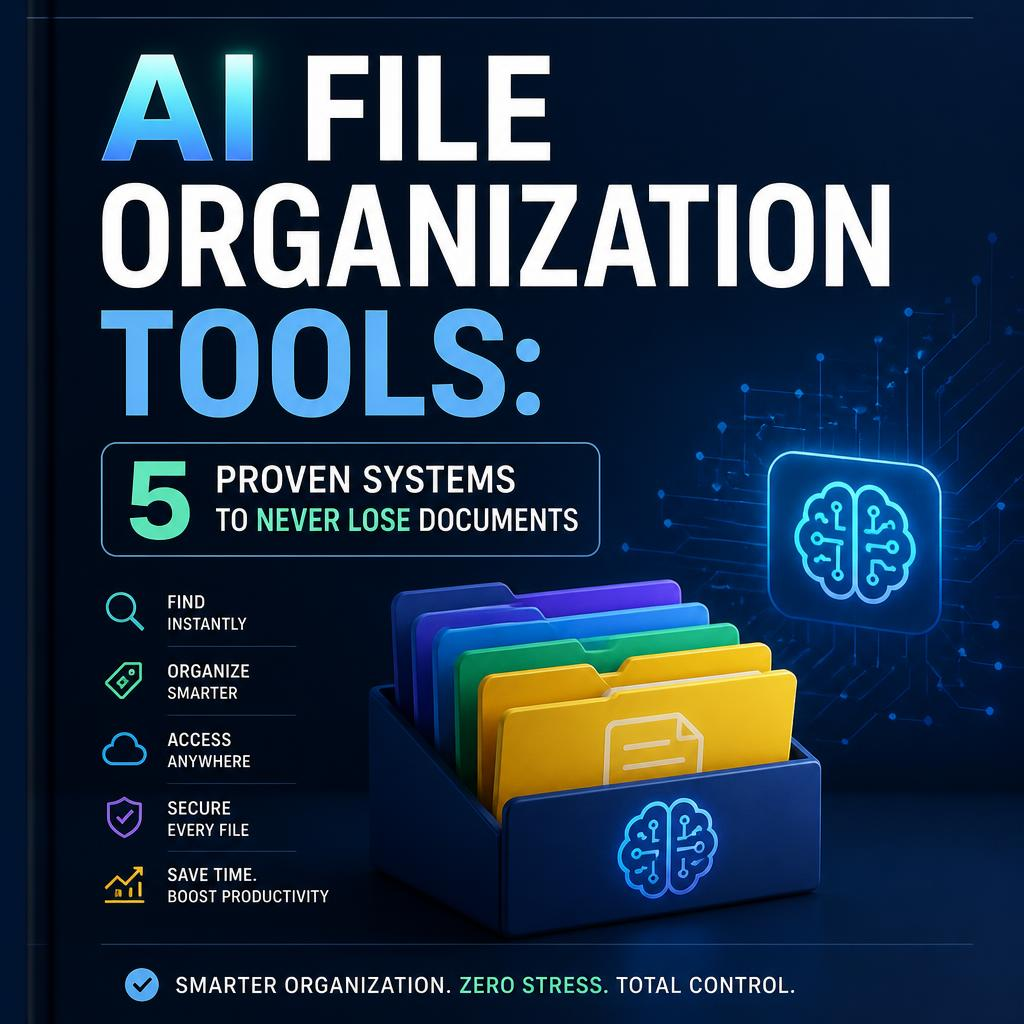
AI file organization tools have evolved from convenience utilities into operational infrastructure. Digital clutter is no longer a minor annoyance. It is a measurable productivity tax. Teams that spend ten minutes daily searching for correct versions, outdated contracts, or duplicated assets accumulate hundreds of lost hours annually. Manual folder structures collapse when document volume exceeds a few thousand files.
This evaluation assesses platforms against precision, interoperability, and long-term maintenance criteria. We are not discussing software that renames files arbitrarily. We are examining systems that understand context, extract metadata automatically, and maintain order without constant intervention. If your document workflow depends on human memory or arbitrary naming conventions, this guide maps the migration path to a scalable model.
- The Operational Cost of Digital Chaos
- Classification Architecture: What AI Must Actually Deliver
- Five Platforms That Solve Structural Disorder
- Implementation Roadmap: Safe Migration Without Breaking Workflows
- Metrics That Validate Investment in Digital Order
- Configuration Failures That Neutralize Automation
- Strategic Selection: Matching Stack to Your Volume
- Frequently Asked Questions
The Operational Cost of Digital Chaos
Storing everything in a shared folder or relying on whatever filename each employee chooses is an unsustainable model. Friction emerges when multiple versions coexist, when contracts expire unnoticed, or when content-based search fails because filenames do not reflect interior content.
AI file organization tools address this problem at its root: they eliminate dependency on manual tagging. They analyze content, extract dates, involved parties, document type, and status, then assign structural labels. Search stops being a guessing game and becomes a precise query.
Direct impact measures across three dimensions: time recovered in searches, reduction of errors from using obsolete versions, and automated regulatory compliance. Organizations ignoring this infrastructure layer assume unnecessary risks in audits, client responses, and internal efficiency.
Classification Architecture: What AI Must Actually Deliver
Not every platform promising order delivers consistency. A viable solution must fulfill four technical functions:
1. Semantic Metadata Extraction The system must read content, not just filenames. A signed contract, pending invoice, or approved design should be classified by what it contains, not by how a user saved it.
2. Contextual Linking Documents rarely exist in isolation. A sales proposal relates to its budget, follow-up email, and final signed version. AI must create automatic threads between related files.
3. Retention and Archiving Rules Order is not static. Active items must remain accessible. Historical items should compress or archive according to legal policies. Lifecycle automation prevents indefinite accumulation.
4. Native Integration with Existing Ecosystems Nobody will manually migrate terabytes. The tool must connect to Google Drive, SharePoint, Dropbox, local disks, and inboxes without breaking permissions or inherited structures.
When evaluating AI file organization tools, demand these capabilities. If one is missing, the system becomes another repository requiring manual cleanup every six months.
Five Platforms That Solve Structural Disorder
The market offers dozens of options. Only these five maintain consistent precision, stable APIs, and measurable ROI in professional environments.
1. DocuClipper – Classification and Extraction for Financial Workflows
Focus: Automation of structured and semi-structured documents. Why It Stands Out: DocuClipper uses computer vision and language models to extract data from invoices, receipts, bank statements, and contracts. It does not just rename files. It generates spreadsheets, accounting records, and expiration alerts automatically. Real Implementation: Accounting firms and finance departments reduce document processing time by 70%. Extraction accuracy for numerical data exceeds 96% after initial calibration. Limitations: Specialized in financially structured documents. Less effective for creative assets or unformatted internal notes. Pricing: From $29/month for basic volume. Enterprise plans with dedicated API available.
Official Site: https://www.docuclipper.com
2. Docsumo – Intelligent Processing for Logistics Operations
Focus: Data extraction and automatic organization for supply chains. Why It Stands Out: Docsumo trains custom models per document type. It recognizes purchase orders, shipping manifests, quality certificates, and customs forms. It classifies, validates against databases, and archives according to compliance rules. Real Implementation: Distribution and retail companies organize thousands of monthly documents without manual intervention. False positive rates drop below 2% after training phase. Limitations: Requires initial template configuration. Not a plug-and-play solution for chaotic environments without prior standardization. Pricing: From $99/month. Scalable by pages processed.
Official Site: https://www.docsumo.com
3. Evernote AI – Contextual Organization for Internal Knowledge
Focus: Structuring notes, attached documents, and tacit knowledge. Why It Stands Out: Evernote integrates AI that summarizes meetings, extracts action items, tags by project, and connects related notes automatically. Its semantic search finds information by concept, not exact keyword. Real Implementation: Product teams and consultancies maintain living knowledge bases. The automatic cleanup feature eliminates duplicates and obsolete versions without deleting critical data. Limitations: Optimized for note environments and light documents. Does not replace enterprise document managers for heavy files or regulatory archives. Pricing: Free with limits. Personal: $14.99/month. Professional: $24.99/month.

Official Site: https://evernote.com
4. M-Files – Metadata-Driven Document Governance
Focus: Enterprise management based on content, not location. Why It Stands Out: M-Files abandons traditional folder structures. Files index by what they are, who created them, their status, and relation to other processes. AI suggests metadata, applies retention policies, and controls versions automatically. Real Implementation: Regulated organizations (healthcare, legal, manufacturing) achieve continuous audits without manual preparation. Critical document retrieval time reduces to seconds. Limitations: Initial learning curve. Requires clear metadata schema definition before mass deployment. Pricing: From $55/user/month. Volume or perpetual models available.

Official Site: https://www.m-files.com
5. FileThis – Consolidation and Categorization for Individuals and SMBs
Focus: Centralization and automatic tagging of scattered files. Why It Stands Out: FileThis connects to bank accounts, utilities, providers, and cloud storage. It downloads statements, invoices, and receipts, renames them with standard conventions, and stores them in logical structures. Real Implementation: Freelancers and small offices eliminate manual review of inboxes and monthly downloads. The system maintains a clean tax archive ready for filing. Limitations: Less granularity in complex semantic classification. Ideal for transactional volume, not creative or technical projects. Pricing: $3.99/month or $29.99/year. Free trial available.

Official Site: https://filethis.com
Implementation Roadmap: Safe Migration Without Breaking Workflows
Deploying AI file organization tools requires discipline. A rushed migration creates duplicates, permission loss, or team resistance. Follow this sequence:
Phase 1: Audit and Pre-Cleanup (Week 1)
- Identify critical repositories (local Drive, cloud, email attachments, external disks)
- Remove obvious duplicates and temporary files
- Define a base metadata schema: type, date, project, status, owner
Phase 2: Connection and Initial Training (Week 2)
- Link the platform to your primary sources
- Upload a test set (200-500 representative documents)
- Review automatic classifications and correct errors. AI learns from your adjustments.
Phase 3: Controlled Deployment (Week 3)
- Activate automatic organization in a pilot department or project
- Monitor precision rates and search times
- Adjust retention rules and expiration notifications
Phase 4: Scaling and Documentation (Week 4)
- Extend to the entire organization
- Create a quick guide for naming conventions and semantic search
- Schedule quarterly policy reviews for archiving
Migration is not a one-time event. It is a continuous refinement process. AI maintains order, but human governance defines the rules.
Metrics That Validate Investment in Digital Order
Implementing automation without measuring impact turns the project into invisible spending. Track these indicators to demonstrate return:
Average Document Retrieval Time Record how long a user takes to find a specific file before and after. A 60-80% reduction is achievable with active semantic classification.
Duplicate and Orphaned Version Rate Measure identical or similar files stored in multiple locations. Proper tools eliminate or link copies automatically. Target: <5% redundancy.
Retention Policy Compliance Percentage of documents archived or deleted per legal calendar. Automation should exceed 95% execution without manual intervention.
Automatic Classification Precision Sample 100 processed files. Verify labels, metadata, and location. Sustained precision above 92% indicates a well-calibrated model.
Team Satisfaction (Internal Survey) Direct question: How much time do you save weekly? Do you feel more confident finding information? Qualitative data validates real adoption.
Document baseline before installation. Repeat measurement at 30, 60, and 90 days. Optimization requires data, not assumptions.
Configuration Failures That Neutralize Automation
Technology rarely fails first. Operational errors do. Avoid these patterns that destroy the value of AI file organization tools:
1. Ignoring the Training Phase Activating automatic classification without reviewing initial outputs generates massive incorrect tagging. Dedicate initial hours to correction. AI replicates your standards, it does not guess them.
2. Migrating Trash Without Filtering If you upload terabytes of temporary files, irrelevant screenshots, or contextless downloads, AI will organize chaos with impeccable precision. Clean first. Classify after.
3. Overloading with Unnecessary Metadata Requiring 15 mandatory fields per document stalls adoption. Start with 4-5 essentials. Add complexity only when workflow demands it.
4. Forgetting Permissions and Security Order must not compromise access. Verify that AI respects roles, restricted folders, and sectoral compliance. Automation without access control is a risk.
5. Expecting Immediate Perfection Models improve with use. Early weeks will show minor errors. Correct, adjust rules, and trust the learning curve. Consistency beats instant precision.
Strategic Selection: Matching Stack to Your Volume
Not all organizations need the same architecture. Decision depends on complexity, regulation, and scale.
For freelancers and small teams (<10 people): FileThis + Evernote AI cover invoicing, internal notes, and semantic search. Low cost, implementation in hours, zero maintenance.
For SMBs and operational departments (10-50 people): DocuClipper or Docsumo depending on sector. Transactional processing, precise extraction, integration with accounting or logistics. Requires 1-2 weeks initial configuration.
For regulated enterprises or high volume (50+ people): M-Files provides complete document governance. Mandatory metadata, automatic retention, continuous auditing. Higher investment, but eliminates compliance risks and critical loss.
The practical rule: start with the most costly pain point. If you lose time searching, prioritize semantic search. If you fail audits, prioritize governance and retention. If the bottleneck is data entry, prioritize automatic extraction.
| Platform | Best For | Setup Complexity | Ideal Volume | Primary Strength |
|---|---|---|---|---|
| DocuClipper | Finance & accounting | Medium | High transactional | Precise extraction |
| Docsumo | Logistics & retail | Medium-High | Structured documents | Custom models |
| Evernote AI | Knowledge & notes | Low | Creative/consultancy teams | Semantic search |
| M-Files | Compliance & enterprise | High | Regulated / 50+ users | Document governance |
| FileThis | SMBs & freelancers | Very Low | Invoicing & receipts | Automatic consolidation |
Frequently Asked Questions
Do AI file organization tools replace document administrators?
No. They automate classification, extraction, and retention. The human professional defines policies, supervises exceptions, and manages relationships with providers or regulators. AI eliminates repetitive work, not strategic judgment.
How long until ROI becomes visible?
Operational indicators (search time, duplicate reduction) improve within 7-14 days. Clear financial return (recovered hours, avoided fines, lower administrative load) consolidates between 45 and 90 days.
Do they work with Spanish and other language files?
Yes. Enterprise platforms support Spanish, Portuguese, French, German, and Italian with high precision. Verify language coverage for your specific plan. Date and numeric format extraction adapts automatically to regions.
Is it safe to upload confidential documents to these platforms?
Professional solutions include encryption in transit and at rest, GDPR/SOC2 compliance, and regional hosting options. Always request the Data Processing Agreement (DPA). Avoid uploading sensitive information to tools without verifiable certification.
Can I integrate these tools with my current software?
Most offer APIs, native connectors for Google Workspace, Microsoft 365, Dropbox, and SharePoint, plus webhooks for custom workflows. Verify compatibility before subscribing. Interoperability defines real utility.
What happens if AI misclassifies an important file?
Serious systems allow manual correction, immediate feedback, and exception rules. A mislabeled document adjusts in seconds and trains the model to avoid repeating the error. Human supervision remains essential in critical phases.