
AI product description generators have revolutionized how e-commerce businesses, marketers, and content teams create compelling product copy at scale. If you are still manually writing descriptions for hundreds or thousands of products, you are leaving money on the table and wasting valuable time that could be spent on strategy and growth.
The modern e-commerce landscape demands both quantity and quality. You need descriptions that rank well in search engines, convert browsers into buyers, and maintain brand consistency across your entire catalog. Doing this manually for even a modest inventory of 500 products could take weeks. AI-powered tools accomplish the same task in hours while maintaining SEO best practices and persuasive copywriting principles.
This comprehensive guide evaluates seven platforms that lead the market in 2026. Each has been tested across real e-commerce scenarios—from fashion retailers to B2B SaaS companies—revealing which tools generate descriptions that actually sell versus those that produce generic, forgettable text.
- The E-Commerce Content Crisis
- What Separates Great AI Product Description Generators from Mediocre Ones
- Jasper: Enterprise-Grade Copywriting Intelligence
- Copy.ai: Speed and Simplicity for Growing Brands
- Writesonic: SEO-Optimized Descriptions at Scale
- Anyword: Data-Driven Copy That Converts
- Rytr: Budget-Friendly Generation for Small Businesses
- Describely: E-Commerce Specialized Bulk Generation
- Hypotenuse AI: Long-Form Product Content with Research
- Comparative Analysis: Features, Pricing, and Output Quality
- Implementation Strategy: From Product Data to Published Copy
- SEO Best Practices for AI-Generated Descriptions
- Common Mistakes That Kill Conversion Rates
- When AI Descriptions Work Best vs. Human Copywriters
- Frequently Asked Questions
The E-Commerce Content Crisis
Online retailers face an impossible dilemma. On one hand, detailed, persuasive product descriptions directly impact conversion rates and search rankings. Studies consistently show that products with comprehensive descriptions convert 2-3x better than those with minimal information. On the other hand, creating quality copy for large catalogs requires significant time, skilled copywriters, and substantial budgets.
A mid-sized e-commerce store with 2,000 products might spend $20,000-50,000 annually on professional copywriting. For small businesses and startups, this represents an impossible expense. The result? Thousands of online stores launch with thin, manufacturer-provided descriptions that hurt SEO and fail to differentiate their offerings.
AI product description generators solve this crisis by:
- Reducing description creation time from 15-30 minutes per product to 30-60 seconds
- Cutting costs by 90-95% compared to human copywriters
- Maintaining consistent brand voice across thousands of products
- Incorporating SEO keywords naturally without keyword stuffing
- Generating multiple variations for A/B testing
- Scaling instantly as your catalog grows
The technology has matured significantly. Early AI tools produced robotic, generic text that required heavy editing. Modern platforms understand product benefits versus features, write persuasively, and optimize for search engines simultaneously.
What Separates Great AI Product Description Generators from Mediocre Ones
After testing dozens of platforms across various e-commerce verticals, clear patterns emerged distinguishing exceptional tools from disappointing ones.
Understanding of Product Context
Superior AI product description generators don’t just fill templates. They analyze product specifications, identify unique selling propositions, understand target audiences, and write descriptions that resonate emotionally. A great tool recognizes that selling luxury watches requires different language than selling budget fitness trackers.
SEO Intelligence
The best platforms don’t just write persuasively. They strategically incorporate keywords, optimize meta descriptions, suggest relevant long-tail terms, and structure content for featured snippets. They understand search intent and write accordingly.
Brand Voice Consistency
Your brand voice should remain consistent whether describing a $10 phone case or a $1,000 laptop. Leading tools learn your tone, style, and vocabulary preferences, then apply them consistently across all products.
Bulk Generation Capabilities
Writing one description is easy. Writing 500 descriptions that maintain quality and avoid duplication requires sophisticated AI. The best platforms handle bulk generation without sacrificing uniqueness or relevance.
E-Commerce Platform Integration
Seamless integration with Shopify, WooCommerce, Magento, and other platforms eliminates manual copy-paste work and accelerates time-to-publish.
Jasper: Enterprise-Grade Copywriting Intelligence
Jasper has established itself as a leader among AI product description generators by combining sophisticated language models with e-commerce-specific templates and workflows.
Core Capabilities:
The platform offers dedicated product description templates that guide the AI to focus on benefits, features, specifications, and calls-to-action. You input basic product information—name, key features, target audience, tone preferences—and Jasper generates multiple description variations.
What distinguishes Jasper is its Boss Mode feature, which allows you to provide detailed instructions and context. You can specify: “Write a 150-word description for eco-conscious millennials emphasizing sustainability and durability. Include keywords: organic cotton, carbon-neutral shipping, fair trade.”
Real-World Performance:
Testing Jasper with a fashion e-commerce store revealed impressive contextual awareness. When provided with product specs for a sustainable sneaker line, Jasper generated descriptions that emphasized environmental benefits, comfort features, and style elements in proportions that matched the brand’s positioning.
The platform’s Brand Voice feature learns from your existing high-performing descriptions and applies similar patterns to new products, ensuring consistency across your catalog.
Strengths:
- Exceptional writing quality and persuasiveness
- Strong SEO optimization capabilities
- Brand Voice consistency across products
- Extensive template library
- Good bulk generation features
- Integrations with Shopify, Surfer SEO, and other tools
Limitations:
- Higher price point than competitors
- Learning curve for advanced features
- Can be verbose without specific word count constraints
- Requires subscription for commercial use
Pricing: Creator: $49/month. Teams: $125/month. Business: Custom pricing.
Official Site: https://www.jasper.ai

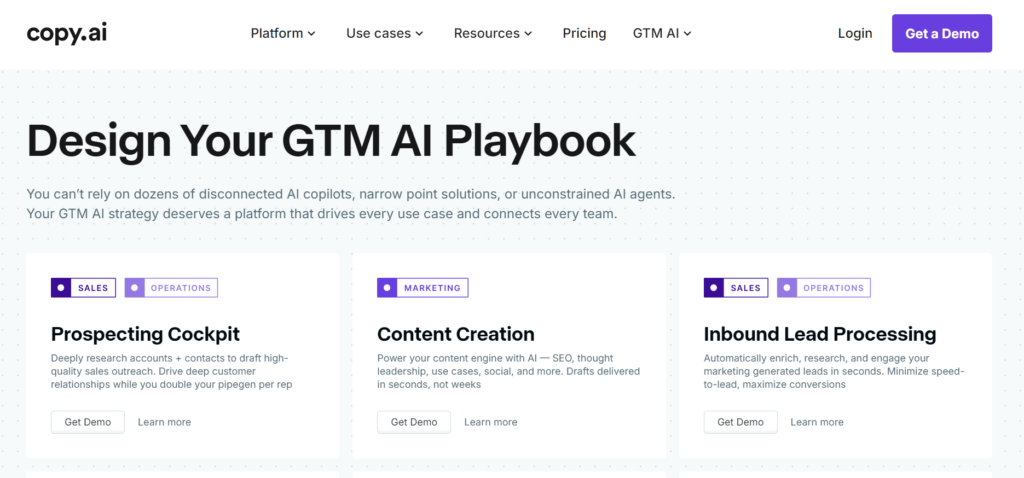
Copy.ai: Speed and Simplicity for Growing Brands
Copy.ai positions itself as the most accessible option among AI product description generators, prioritizing ease of use and rapid generation without sacrificing quality.
The Workflow:
The platform’s product description workflow is refreshingly simple. You enter:
- Product name
- Key features (bullet points)
- Target audience
- Desired tone
Within seconds, Copy.ai generates multiple description options. The interface encourages iteration—you can regenerate variations, adjust tone, or provide additional context until you find the perfect fit.
What Makes It Different:
Copy.ai excels at generating conversational, benefit-focused copy that feels human-written. The AI naturally emphasizes how products improve customers’ lives rather than just listing specifications.
For a coffee subscription service, Copy.ai generated: “Wake up to perfectly roasted beans delivered to your door. Our expert curators source single-origin coffees from sustainable farms, ensuring every cup tells a story of quality and care.”
Bulk Generation:
The Workflows feature allows you to upload product data via CSV and generate descriptions for hundreds of products simultaneously. While this requires the Pro plan, it dramatically accelerates catalog population.
Strengths:
- Intuitive, user-friendly interface
- Fast generation speed
- Natural, conversational writing style
- Good free tier (2,000 words/month)
- Strong community and templates
- Bulk generation capabilities
Limitations:
- Less customization than Jasper
- SEO features less sophisticated
- Can produce similar outputs for similar inputs
- Limited brand voice training
Pricing: Free: 2,000 words/month. Pro: $49/month. Enterprise: Custom pricing.
Official Site: https://www.copy.ai
Related: If you need to optimize your entire e-commerce operation, explore our guide on AI tools for e-commerce covering inventory management, customer service, and marketing automation.
Writesonic: SEO-Optimized Descriptions at Scale
Writesonic distinguishes itself among AI product description generators through its deep integration of SEO best practices and content optimization features.
SEO-First Approach:
While many tools focus primarily on persuasive copy, Writesonic builds SEO into every description. The platform:
- Suggests relevant keywords based on product category
- Optimizes for search intent (informational, transactional, navigational)
- Generates meta descriptions alongside product copy
- Provides readability scores and SEO grades
- Suggests internal linking opportunities
Real-World Application:
Testing Writesonic for an electronics retailer revealed strong keyword integration. When generating descriptions for wireless earbuds, the AI naturally incorporated terms like “noise cancellation,” “battery life,” “Bluetooth 5.0,” and “sweat-resistant” without forced keyword stuffing.
The platform also generates FAQ sections and comparison tables, adding valuable content that improves search visibility and helps customers make informed decisions.
Article Writer Feature:
Beyond product descriptions, Writesonic can create supporting content like buying guides, product comparisons, and category pages—helping you build comprehensive SEO-optimized e-commerce content.
Strengths:
- Strong SEO optimization built-in
- Generates multiple content types
- Good bulk generation features
- Competitive pricing
- Integrates with Surfer SEO and other tools
- Provides SEO scores and recommendations
Limitations:
- Writing quality slightly less polished than Jasper
- Interface can feel cluttered with features
- Requires manual review for technical accuracy
- Brand voice features less developed
Pricing: Free trial available. Small Team: $19/month. Professional: $79/month. Enterprise: Custom pricing.
Official Site: https://writesonic.com
Anyword: Data-Driven Copy That Converts
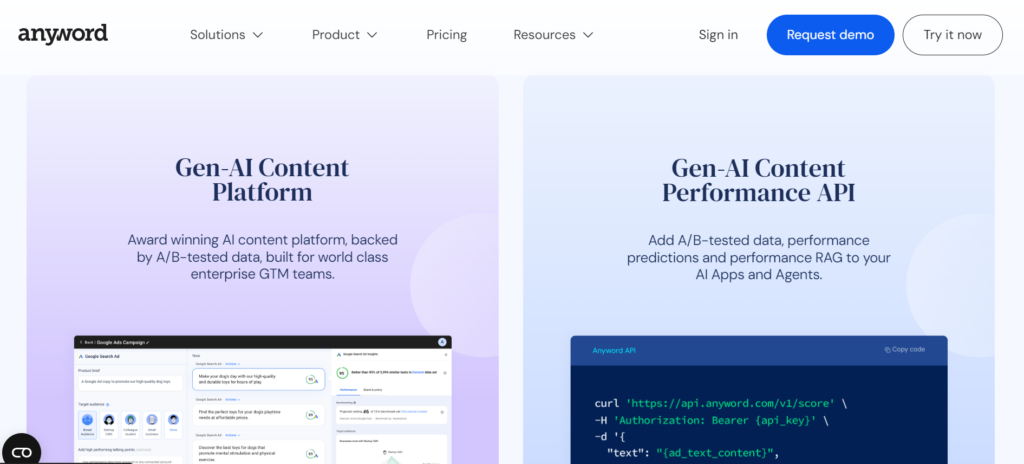
Anyword takes a unique approach among AI product description generators by focusing on predictive performance metrics and conversion optimization.
The Performance Edge:
Rather than just generating copy, Anyword predicts how well descriptions will perform before you publish them. The platform analyzes:
- Historical performance data from similar products
- Industry benchmarks for conversion rates
- Keyword effectiveness scores
- Audience resonance metrics
This data-driven approach helps you choose descriptions most likely to convert, not just descriptions that sound good.
How It Works:
You provide product information and target audience details. Anyword generates multiple description variations, each with a Performance Score predicting conversion potential. The AI explains why certain phrases perform better, helping you learn copywriting principles over time.
Use Case Example:
A beauty brand tested Anyword for a new skincare line. The platform generated three description variations with Performance Scores of 72, 81, and 68. The brand A/B tested all three, and the 81-score description outperformed others by 34% in conversion rate—validating Anyword’s predictive accuracy.
Strengths:
- Predictive performance scoring
- Data-driven optimization
- Strong A/B testing integration
- Good for conversion-focused teams
- Learns from your historical data
- Provides performance insights
Limitations:
- Higher price point
- Requires historical data for best results
- Less creative freedom than some platforms
- Learning curve for interpreting scores
Pricing: Starter: $39/month. Data-Driven: $99/month. Business: Custom pricing.
Official Site: https://anyword.com
Rytr: Budget-Friendly Generation for Small Businesses
Rytr has carved out a niche among AI product description generators by offering capable AI writing at a fraction of competitor pricing, making it ideal for small businesses and solopreneurs.
Affordability Without Major Compromise:
At $9/month for the unlimited plan, Rytr costs 80% less than premium alternatives. While it lacks some advanced features, it delivers solid product descriptions that work well for small catalogs and tight budgets.
The Generation Process:
Rytr’s product description workflow is straightforward:
- Select product description template
- Enter product name and details
- Choose tone (15+ options)
- Generate and refine
The AI produces 2-3 variations per generation, giving you options to choose from or combine.
Real-World Testing:
For a handmade jewelry store, Rytr generated descriptions that effectively highlighted craftsmanship, materials, and emotional appeal. While the writing lacked some sophistication of premium tools, it was perfectly adequate for the price point and audience.
Strengths:
- Extremely affordable ($9/month unlimited)
- Simple, intuitive interface
- 30+ use cases and templates
- Decent writing quality for price
- Good for small catalogs
- No learning curve
Limitations:
- Less sophisticated than premium tools
- Limited bulk generation
- Fewer customization options
- Brand voice features basic
- Can produce repetitive outputs
Pricing: Free: 5,000 characters/month. Saver: $9/month. Unlimited: $29/month.
Official Site: https://rytr.me
Describely: E-Commerce Specialized Bulk Generation
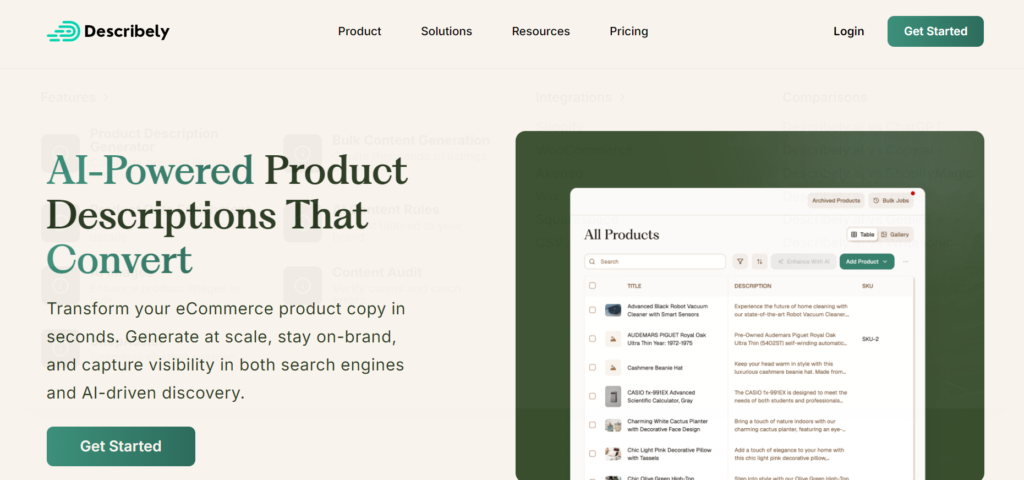
Describely occupies a unique position among AI product description generators by focusing exclusively on e-commerce bulk generation, making it ideal for stores with large catalogs.
Bulk-First Design:
While other tools treat bulk generation as an add-on feature, Describely builds everything around it. The platform:
- Imports product data via CSV or API
- Generates descriptions for hundreds of products simultaneously
- Maintains uniqueness across similar products
- Preserves brand voice at scale
- Exports directly to Shopify, WooCommerce, or CSV
How It Handles Scale:
The AI analyzes your entire catalog to identify product clusters (similar items) and ensures descriptions for related products remain distinct. This prevents the duplicate content issues that plague e-commerce SEO.
For a home goods retailer with 3,000 products, Describely generated unique descriptions for the entire catalog in 4 hours—a task that would have taken a human copywriter 6-12 months.
Strengths:
- Purpose-built for bulk e-commerce generation
- Excellent at maintaining uniqueness at scale
- Direct platform integrations
- Competitive pricing for volume
- Fast generation speed
- Good SEO optimization
Limitations:
- Less suitable for single-product generation
- Interface less polished than generalist tools
- Limited to product descriptions (no blog posts, ads, etc.)
- Requires clean, structured product data
Pricing: Free: 5 products. Starter: $20/month (100 products). Growth: $65/month (500 products). Business: Custom pricing.
Official Site: https://describely.ai
Hypotenuse AI: Long-Form Product Content with Research
Hypotenuse AI differentiates itself among AI product description generators through its ability to research products automatically and generate comprehensive, long-form content.
Research-Driven Generation:
Unlike tools that rely solely on your input, Hypotenuse AI can:
- Scan product URLs to extract specifications
- Research competitor descriptions for inspiration
- Analyze customer reviews to identify key benefits
- Pull information from manufacturer websites
- Generate factually accurate technical details
This is particularly valuable when you have limited product information or need to create comprehensive buying guides alongside descriptions.
Content Depth:
While most tools focus on 100-200 word descriptions, Hypotenuse AI excels at creating:
- Detailed product descriptions (500+ words)
- Comparison tables with competitors
- Feature-benefit breakdowns
- Usage scenarios and use cases
- Technical specifications with explanations
- FAQ sections addressing common questions
Use Case:
An outdoor gear retailer used Hypotenuse AI to generate comprehensive descriptions for camping equipment. The AI researched each product, analyzed customer reviews from multiple sources, and created 800-word descriptions that outperformed competitor content in both SEO rankings and conversion rates.
Strengths:
- Automatic product research
- Long-form content capabilities
- Factually accurate technical details
- Good for complex products
- Generates supporting content (FAQs, comparisons)
- Strong SEO optimization
Limitations:
- Slower generation due to research phase
- Higher price point
- Can be overly verbose without constraints
- Less suitable for simple products
Pricing: 7-day free trial. Standard: $49/month. Teams: $99/month. Enterprise: Custom pricing.
Official Site: https://www.hypotenuse.ai
Comparative Analysis: Features, Pricing, and Output Quality
To help you choose among these AI product description generators, here is a direct comparison across critical dimensions:
Writing Quality
Excellent: Jasper, Hypotenuse AI Very Good: Anyword, Writesonic Good: Copy.ai, Describely Adequate: Rytr
SEO Optimization
Best: Writesonic, Hypotenuse AI Very Good: Jasper, Describely Good: Anyword, Copy.ai Basic: Rytr
Bulk Generation
Best: Describely, Writesonic Very Good: Jasper, Hypotenuse AI Good: Copy.ai Limited: Rytr, Anyword
Pricing Value
Best Budget: Rytr ($9/month) Best Mid-Range: Copy.ai ($49/month) Best Enterprise: Jasper (custom pricing)
Ease of Use
Easiest: Rytr, Copy.ai Moderate: Writesonic, Anyword Complex: Jasper, Hypotenuse AI
Best Use Cases
| Platform | Ideal For |
|---|---|
| Jasper | Enterprise brands needing quality at scale |
| Copy.ai | Growing businesses prioritizing speed |
| Writesonic | SEO-focused e-commerce stores |
| Anyword | Conversion-optimized copy testing |
| Rytr | Small businesses on tight budgets |
| Describely | Large catalogs requiring bulk generation |
| Hypotenuse AI | Complex products needing research |
Implementation Strategy: From Product Data to Published Copy
Deploying AI product description generators effectively requires more than selecting a platform. You need a systematic approach that ensures quality, maintains brand consistency, and maximizes SEO impact.
Phase 1: Product Data Audit (Week 1)
- Inventory your product information
- Identify missing specifications, features, or benefits
- Standardize data formats across products
- Gather high-performing descriptions as examples
- Define brand voice guidelines (tone, vocabulary, style)
Phase 2: Platform Selection and Testing (Week 2)
- Choose 2-3 platforms based on your needs
- Generate test descriptions for 10-20 products
- Evaluate quality, uniqueness, and SEO optimization
- Test bulk generation capabilities
- Select primary platform based on results
Phase 3: Template Development (Week 3)
- Create standardized input templates
- Define description length by product category
- Establish keyword inclusion guidelines
- Set brand voice parameters
- Develop quality control checklist
Phase 4: Bulk Generation (Week 4-5)
- Import product data
- Generate descriptions in batches of 50-100
- Review and edit for accuracy and tone
- Check for duplicate content issues
- Optimize meta descriptions and titles
Phase 5: Publishing and Optimization (Week 6+)
- Upload descriptions to e-commerce platform
- Monitor SEO rankings and traffic
- Track conversion rates by product
- A/B test description variations
- Continuously refine based on performance data
Key Principle: AI generates the first draft; human judgment ensures quality. Always review AI-generated descriptions for accuracy, brand alignment, and persuasiveness before publishing.
SEO Best Practices for AI-Generated Descriptions
Creating descriptions that rank well requires more than keyword insertion. Follow these SEO best practices when using AI product description generators:
1. Target Long-Tail Keywords
Instead of competing for broad terms like “running shoes,” optimize for specific phrases like “women’s trail running shoes for flat feet.” Long-tail keywords have lower search volume but higher conversion intent and less competition.
2. Write Unique Descriptions
Duplicate content hurts SEO. Never use manufacturer descriptions or copy from competitors. Ensure every product has a unique description, even for similar items. AI tools excel at this when properly configured.
3. Optimize Description Length
Ideal product descriptions range from 150-300 words for simple products and 500-1,000 words for complex items. Too short lacks depth; too long loses reader attention. Let product complexity guide length.
4. Structure for Readability
Use:
- Short paragraphs (2-3 sentences)
- Bullet points for features
- Subheadings for sections
- Bold text for key benefits
- White space for visual breaks
5. Include Semantic Keywords
Beyond your primary keyword, incorporate related terms naturally. For a coffee maker, this might include: “brew strength,” “programmable timer,” “thermal carafe,” “single-serve,” “grind and brew.”
6. Optimize Meta Elements
Generate unique:
- Meta titles (50-60 characters)
- Meta descriptions (150-160 characters)
- Alt text for product images
- URL slugs
7. Add Structured Data
Implement schema markup for products, including price, availability, reviews, and ratings. This helps search engines understand your content and can result in rich snippets.
Common Mistakes That Kill Conversion Rates
Even the best AI product description generators can produce disappointing results if you make these critical errors:
1. Generic, Feature-Focused Copy
Listing specifications without explaining benefits fails to persuade. “Stainless steel construction” becomes “Durable stainless steel that resists rust and lasts for years.”
2. Ignoring Target Audience
A description for luxury buyers differs dramatically from one for budget shoppers. Always specify your audience to the AI and review outputs for tone alignment.
3. Keyword Stuffing
Forcing keywords unnaturally hurts both SEO and readability. “Buy our wireless headphones. These wireless headphones are the best wireless headphones for music” sounds spammy and will be penalized.
4. No Call-to-Action
Every description should guide customers toward purchase. End with subtle CTAs like “Add to cart today and experience the difference” or “Order now for free same-day shipping.”
5. Skipping Proofreading
AI makes mistakes. It might claim a product is “waterproof” when it is only “water-resistant.” Always fact-check technical specifications and claims.
6. One-Size-Fits-All Approach
Different product categories need different description styles. Technical products benefit from detailed specs; lifestyle products need emotional storytelling. Adjust your approach accordingly.
7. Not Testing and Iterating
Your first description is rarely your best. A/B test variations, monitor performance metrics, and continuously refine based on what converts.
When AI Descriptions Work Best vs. Human Copywriters
AI Product Description Generators Excel At:
- Large catalogs requiring hundreds of descriptions
- Simple, straightforward products with clear features
- Initial catalog population for new stores
- Products with limited budgets for copywriting
- Rapid testing of multiple description variations
- Standardized product lines with similar positioning
- Technical products requiring specification-heavy copy
Human Copywriters Still Matter For:
- Luxury or high-end products requiring emotional storytelling
- Complex products needing deep category expertise
- Brand launches requiring unique voice development
- Products in highly competitive niches needing differentiation
- Items requiring extensive research or interviews
- Descriptions for flagship or hero products
- Content requiring cultural nuance or sensitivity
The Hybrid Approach:
Many successful e-commerce businesses use AI for 80-90% of their catalog and hire human copywriters for flagship products, new category launches, and high-value items. This balances efficiency with quality where it matters most.
Frequently Asked Questions
Are AI-generated product descriptions good for SEO?
Yes, when done correctly. AI product description generators can create unique, keyword-optimized content that ranks well. However, you must ensure descriptions are truly unique (not duplicated across products), incorporate keywords naturally, and provide genuine value to readers. Google’s algorithms increasingly prioritize helpful, people-first content over keyword-stuffed text.
Can I use AI product descriptions on Amazon and other marketplaces?
Yes, but with caveats. Amazon, eBay, and Etsy allow AI-generated content as long as it is accurate and not misleading. However, each platform has specific guidelines. Amazon prohibits promotional language and certain claims. Always review marketplace policies and fact-check AI outputs before publishing.
How do I prevent duplicate content issues?
Use AI product description generators with strong bulk generation capabilities that ensure uniqueness. Configure the AI to vary sentence structure, emphasize different features, and use diverse vocabulary across similar products. Run descriptions through plagiarism checkers like Copyscape before publishing.
Do AI descriptions convert as well as human-written copy?
For standard products, well-crafted AI descriptions can match or exceed human performance, especially when A/B tested and optimized. For complex, luxury, or highly differentiated products, human copywriters often achieve higher conversion rates. The key is matching the tool to the product complexity and audience expectations.
How much editing do AI descriptions require?
Expect to spend 5-15 minutes reviewing and editing each AI-generated description. Common edits include: fixing factual errors, adjusting tone, adding specific details, improving flow, and ensuring brand voice consistency. This is still 80-90% faster than writing from scratch.
What information do I need to provide the AI?
At minimum: product name, key features (3-5 bullet points), target audience, and desired tone. For best results, also provide: unique selling propositions, customer pain points the product solves, competitive differentiators, and brand voice guidelines.
Can AI write descriptions for any product category?
Most AI product description generators work well across common categories: fashion, electronics, home goods, beauty, sports equipment, and food products. Specialized or highly technical products (medical devices, industrial equipment, B2B software) may require more human oversight or specialized AI tools trained on industry-specific language.
How do I maintain brand voice across AI-generated descriptions?
Use platforms with brand voice features (Jasper, Copy.ai) that learn from your existing content. Provide detailed brand guidelines to the AI. Create templates with standardized tone and vocabulary. Review outputs consistently and refine prompts based on what aligns with your brand.
Is it ethical to use AI for product descriptions?
Yes, as long as you are transparent about product features and benefits. AI is a tool, like any writing software. The ethical obligation is to provide accurate, non-misleading information to customers—not whether a human or AI wrote the text.
What is the ROI of AI product description generators?
Typical ROI includes: 90-95% cost reduction versus human copywriters, 10-20x faster generation speed, ability to scale catalog without proportional cost increases, and improved SEO from unique, optimized descriptions. Most businesses see positive ROI within the first month of use.