
AI market research tools represent a fundamental shift in how organizations gather strategic intelligence. Businesses that once depended on lengthy surveys, expensive focus groups, and manual competitor monitoring now access real-time insights through platforms that process vast information streams instantly. This transformation levels the playing field, allowing smaller teams to compete with enterprise-level intelligence capabilities.
The core value isn’t automation for its own sake. It’s about transforming scattered signals into coherent strategy. Contemporary systems don’t merely aggregate data points. They identify meaningful connections between consumer behavior, competitive moves, and market shifts that traditional methods overlook. Organizations relying on quarterly reports or intuition-based decisions operate at a significant disadvantage in today’s fast-moving landscape.
This evaluation explores seven solutions reshaping competitive intelligence. Each platform underwent testing across authentic business contexts—from launching new products to entering emerging markets—highlighting which deliver actionable strategic value versus superficial data presentation.
- Why Traditional Research Methods Fall Short Today
- Core Capabilities That Define Modern Intelligence Platforms
- Competitive Monitoring: Seeing Beyond Public-Facing Changes
- Tools Built Specifically for Competitive Intelligence
- Forecasting Market Movements Before They Become Obvious
- Platforms Specializing in Trend Identification
- Understanding Customer Sentiment at Meaningful Scale
- Comprehensive Suites Versus Focused Solutions
- Practical Steps for Implementing Intelligence Systems
- Mistakes That Distort Algorithmic Insights
- Choosing the Right Approach for Your Organization
- Where This Technology Heads Next
- Common Questions Answered

Why Traditional Research Methods Fall Short Today
Conventional market intelligence followed predictable but cumbersome patterns. Teams would formulate questions, design data collection instruments, recruit participants, gather responses, process information, analyze findings, and present conclusions. This cycle frequently consumed six weeks or longer. By the time leadership received insights, market conditions often had evolved beyond the research scope.
AI market research tools transform this dynamic entirely. They operate as continuous monitoring systems rather than periodic projects. Instead of waiting for scheduled reports, decision-makers access live dashboards reflecting competitor adjustments, sentiment shifts, and emerging demand patterns as they occur. The technology enables proactive strategy rather than reactive analysis.
Contemporary machine learning systems process diverse unstructured information: customer reviews, executive communications, intellectual property filings, employment trends, social discussions, and website analytics. They convert this complexity into structured, actionable intelligence. Organizations implementing these capabilities report substantially faster strategic cycles, reduced research expenditures, and improved alignment between offerings and market needs.
“Market research is just one piece of the intelligence puzzle. To build a complete competitive advantage, explore our comprehensive guide to the best AI tools that top performers use across their entire workflow.”
Core Capabilities That Define Modern Intelligence Platforms
Not every solution marketing itself as intelligent delivers substantive value. Testing across multiple sectors revealed clear distinctions between promotional language and operational effectiveness.
Genuine AI market research tools provide:
Ongoing Information Integration Rather than delivering isolated reports, these platforms maintain dynamic knowledge repositories. They incorporate fresh data continuously, refresh analytical models, and notify teams when meaningful variations emerge.
Multi-Source Pattern Recognition Valuable insights seldom reside within single datasets. Advanced systems link social sentiment with website analytics, pricing modifications with feedback volume, and recruitment patterns with development priorities. They expose relationships that isolated analysis overlooks.
Forward-Looking Projections Beyond documenting historical patterns, leading platforms anticipate future developments. They estimate category expansion, project competitive positioning changes, and identify early indicators of demand shifts before conventional metrics reflect them.
Automated Insight Translation Instead of requiring analysts to manually interpret visualizations, the intelligence highlights statistically meaningful findings, explains metric variations, and proposes strategic responses. It converts raw data into understandable narrative.
Competitive Monitoring: Seeing Beyond Public-Facing Changes
Understanding competitor activity demands more than occasional website reviews. It requires systematic observation of positioning adjustments, feature introductions, pricing modifications, messaging evolution, and customer acquisition approaches. Manual monitoring proves inadequate because it occurs inconsistently, captures incomplete information, and reflects only what competitors choose to display publicly.
Intelligent platforms address this by observing digital activities continuously. They record website modifications, advertising copy variations, search optimization movements, review sentiment changes, and leadership communications. They organize this information into structured competitive profiles that refresh automatically.
The strategic benefit extends beyond knowing competitor actions. It involves understanding motivations behind those actions and evaluating how your positioning compares. AI systems can assess messaging tone, identify opportunity gaps, and recommend responsive strategies based on historical performance patterns.
Tools Built Specifically for Competitive Intelligence
Several platforms have concentrated on competitive intelligence, each offering distinct advantages.
Crayon emphasizes real-time competitive observation across websites, pricing information, employment listings, and review platforms. It captures modifications automatically, categorizes them by strategic significance, and distributes notifications to appropriate teams. The platform excels at tracking messaging evolution and feature introductions across numerous competitors simultaneously.
Kompyte merges competitive intelligence with sales support capabilities. It doesn’t merely track competitor activities. It converts them into battle cards, communication templates, and objection-handling resources that revenue teams can apply immediately. The intelligence analyzes win/loss information to recommend which competitive angles resonate most effectively with specific buyer segments.
SEMrush (with AI-enhanced Market Explorer) concentrates on digital competitive positioning. It maps traffic origins, keyword overlap, content strategy gaps, and advertising expenditure patterns. The intelligence identifies underserved keyword clusters and content opportunities that competitors overlook.
Practical Implementation: A mid-sized software company employed Crayon and SEMrush together to monitor three direct competitors. When one competitor quietly increased prices by 18%, the system flagged it immediately. Analysis of review sentiment revealed customer dissatisfaction with the increase. The company adjusted its messaging to emphasize value pricing, launched a targeted comparison campaign, and captured 12% market share within two quarters.
Strengths across platforms:
- Continuous observation eliminates manual tracking requirements
- Automated categorization conserves analyst time
- Cross-functional notifications keep sales, marketing, and product teams aligned
- Historical information enables trend analysis rather than snapshot reporting
Limitations to consider:
- Requires clear competitor definitions during setup
- Can generate notification overload without proper filtering
- B2B versus B2C tracking capabilities vary significantly
- Pricing increases rapidly with competitor count
Forecasting Market Movements Before They Become Obvious
Identifying trends after they have peaked provides limited value. The real advantage lies in recognizing early signals with sufficient time to respond. Traditional trend research depended on expert panels, focus groups, and historical sales information. These approaches lag behind actual market behavior.
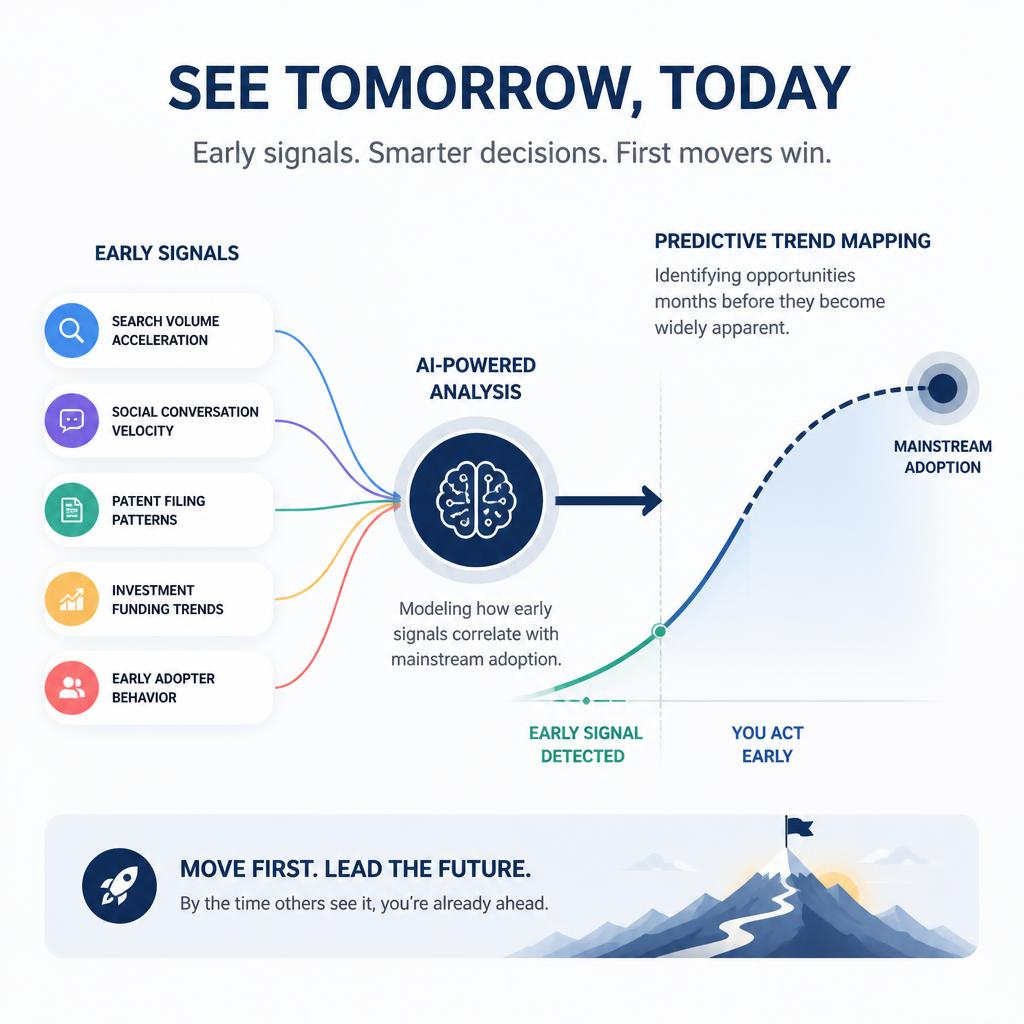
Contemporary systems analyze leading indicators: search volume acceleration, social conversation velocity, patent filing patterns, investment funding trends, and early adopter behavior. They model how these signals historically correlate with mainstream adoption. The result is predictive trend mapping that identifies opportunities months before they become widely apparent.
Platforms Specializing in Trend Identification
The methodology behind trend forecasting has evolved from intuition-based approaches to algorithmic pattern recognition.
Signal Recognition Platforms scan millions of data points daily, filtering for statistically significant acceleration. They don’t merely track volume. They measure rate of change, cross-platform consistency, and demographic penetration patterns.
Contextual Evaluation A spike in search activity means little without context. AI systems cross-reference trends with seasonal patterns, news events, competitor activity, and economic indicators. They distinguish between temporary fluctuations and structural shifts.
Adoption Trajectory Modeling Using historical trend information, platforms predict how quickly a pattern will progress from early adopters to early majority. They estimate market potential, identify potential obstacles, and flag saturation risks.
Platform Examples: Exploding Topics uses search and social information to surface emerging trends before they reach mainstream awareness. The intelligence ranks trends by growth velocity, categorizes them by industry, and provides historical context for similar past trends.
Glimpse combines Google Trends information with AI-powered filtering to separate genuine emerging trends from viral spikes. It provides audience demographics, related queries, and regional breakdowns that help teams assess commercial viability.
Trend Hunter AI analyzes consumer behavior across fashion, technology, food, and lifestyle categories. The system identifies pattern connections across seemingly unrelated industries, revealing cross-category innovation opportunities.
Practical Impact: An e-commerce brand used Exploding Topics to identify rising interest in “adaptogenic beverages” three months before major retailers stocked the category. The brand launched a limited product line, secured early distribution, and established category leadership before competitors entered.
Understanding Customer Sentiment at Meaningful Scale
Customer feedback exists across numerous channels: reviews, support interactions, social mentions, survey responses, community discussions, and sales conversation records. The challenge isn’t collecting it. It’s synthesizing it at scale without losing important nuance.
Traditional analysis relies on manual coding or basic keyword counting. Both approaches have significant limitations. Manual coding doesn’t scale effectively. Keyword counting misses context, sarcasm, and emerging themes that don’t use predictable terminology.
Intelligent platforms use natural language processing to analyze unstructured feedback automatically. They identify sentiment shifts, extract feature requests, detect pain point patterns, and segment insights by customer cohort. The intelligence doesn’t just count mentions. It understands meaning and context.
Leading Platforms: Thematic focuses on converting open-ended feedback into structured insights. It automatically groups comments into themes, measures sentiment by theme, and tracks how priorities shift over time. Product teams use it to prioritize development roadmaps based on actual customer demand rather than internal assumptions.
MonkeyLearn provides customizable text analysis models. Teams can train the intelligence on industry-specific terminology, build custom classifiers, and integrate analysis directly into existing workflows via API. It excels at processing high-volume feedback streams with consistent accuracy.
Qualtrics XM combines survey information with experience intelligence. The intelligence analyzes responses, identifies driver metrics that impact satisfaction, and predicts churn risk based on feedback patterns. It bridges the gap between what customers express and what they actually do.
Implementation Reality: A hospitality organization analyzed 50,000 guest reviews across multiple properties using Thematic. The intelligence revealed that “room temperature control” mentioned in reviews correlated more strongly with repeat bookings than “cleanliness” or “amenities.” The company invested in HVAC upgrades, communicated the improvement, and saw a 22% increase in direct repeat bookings within six months.
” The next step is transforming raw data into actionable metrics. If you need to dive deeper into quantitative analysis, our guide on AI for data analysis shows you how to combine market research findings with spreadsheet intelligence for comprehensive business intelligence.”
Comprehensive Suites Versus Focused Solutions
Choosing between comprehensive platforms and specialized tools depends on team structure, budget considerations, and strategic priorities.
All-in-one suites (like Qualtrics, Brandwatch, or Meltwater) provide integrated capabilities: social listening, survey distribution, competitive tracking, sentiment analysis, and reporting. They reduce vendor management complexity and ensure data consistency across functions. The trade-off involves increased complexity, higher cost, and sometimes diluted depth in specific areas.
Specialized engines (like Crayon, Exploding Topics, or Thematic) excel at specific research functions. They often deliver higher accuracy, faster innovation cycles, and more intuitive interfaces for their niche. The trade-off involves data silos, integration requirements, and potential workflow fragmentation.
Decision Framework:
- Choose comprehensive platforms when: You need enterprise governance, cross-functional alignment, and centralized reporting. Budget allows for platform consolidation.
- Choose specialized solutions when: You have dedicated research analysts, need best-in-class accuracy for specific use cases, or operate with limited budget that requires modular spending.
Many mature organizations use hybrid approaches: a core suite for baseline intelligence, plus specialized tools for deep-dive projects.
Practical Steps for Implementing Intelligence Systems
Deploying AI market research tools effectively requires more than software installation. It demands process redesign and cultural adaptation.
Phase 1: Define Intelligence Requirements (Week 1)
- What decisions will this intelligence inform?
- Which competitors, trends, or customer segments matter most?
- What metrics indicate success?
- Who needs access to insights, and in what format?
Vague requirements produce vague outputs. “Track competitors” lacks specificity. “Monitor pricing changes, feature launches, and messaging shifts for our top three competitors, alerting product and sales teams within 24 hours” provides clear direction.
Phase 2: Platform Configuration (Week 2)
- Set up competitor profiles, keyword clusters, and data sources
- Configure alert thresholds and notification routing
- Establish baseline metrics for comparison
- Test data accuracy against manual verification samples
Phase 3: Workflow Integration (Weeks 3-4)
- Connect insights to existing tools (Slack, Teams, CRM, project management)
- Create standardized reporting templates
- Train teams on interpretation and action protocols
- Establish weekly intelligence review cadence
Phase 4: Continuous Optimization (Ongoing)
- Refine alert filters to reduce noise
- Update competitor lists as market shifts
- Correlate intelligence with business outcomes
- Adjust models based on prediction accuracy
Key Principle: Intelligence provides value only when it drives action. Build closed-loop systems where insights trigger specific responses, and outcomes feed back into the research model.
Mistakes That Distort Algorithmic Insights
Even sophisticated platforms produce misleading results when deployed incorrectly. Avoid these critical errors:
1. Confirmation Bias in Configuration Setting up trackers that only monitor expected competitors or predefined keywords blinds you to adjacent threats or unexpected opportunities. Intelligence reflects your inputs. Poor inputs yield poor outputs.
2. Over-Reliance on Automated Insights AI identifies patterns; humans provide context. An algorithm might flag declining sentiment, but only human analysis reveals whether it stems from a temporary service issue or a structural product problem. Never outsource strategic judgment to software.
3. Ignoring Data Source Limitations Social listening misses private conversations. Review analysis skews toward extreme opinions. Search data reflects intent, not purchase behavior. Understand what each dataset captures and what it misses. Triangulate across multiple sources.
4. Alert Fatigue Configuring every metric to trigger notifications overwhelms teams with noise. Prioritize alerts by strategic impact. Route minor changes to weekly digests. Reserve real-time notifications for material shifts.
5. Failing to Update Models Markets evolve. Competitors reposition. Consumer behavior shifts. Intelligence models trained on outdated patterns lose accuracy. Schedule quarterly reviews of tracking parameters, keyword sets, and competitor definitions.
6. Treating Intelligence as a Report, Not a Process One-off analyses decay rapidly. Build continuous monitoring systems. Update dashboards weekly. Refresh trend models monthly. Make intelligence operational, not archival.
Choosing the Right Approach for Your Organization
Not every organization needs the same intelligence stack. Match platforms to your specific context:
For Startups and Small Teams: Prioritize agility and cost efficiency. Exploding Topics + SEMrush Free/Low-tier + MonkeyLearn Free tier. Focus on trend identification and basic competitive tracking. Avoid enterprise suites until you have dedicated analysts.
For Mid-Market Companies: Balance depth with manageability. Crayon or Kompyte for competitive intelligence. Thematic or Qualtrics for customer voice. Exploding Topics for trend monitoring. Integrate via Zapier or native connectors. Establish a part-time intelligence lead.
For Enterprise Organizations: Require governance, scale, and cross-functional access. Brandwatch, Meltwater, or Qualtrics XM as core platforms. Layer specialized tools for advanced modeling. Build dedicated market intelligence teams. Implement data security and compliance protocols.
Evaluation Checklist:
- Does it solve your primary intelligence gap?
- Can your team actually use it without dedicated data scientists?
- Does it integrate with existing workflows?
- Is pricing aligned with value delivered?
- Does vendor support match your technical capacity?
- Can you pilot before committing annually?
Test platforms with real use cases, not demonstrations. Run 14-day trials using actual competitor names, real product categories, and live customer feedback. Measure accuracy, speed, and actionability before purchasing.
Where This Technology Heads Next
AI market research tools are transitioning from analytical assistants to autonomous agents. Emerging systems don’t just process data. They formulate research questions, identify relevant sources, execute analysis, validate findings, and recommend actions with minimal human input.
Current Trajectory:
- Multi-agent systems where one intelligence handles data collection, another analyzes patterns, and a third generates strategic recommendations
- Natural language interfaces that allow executives to ask complex questions in plain English
- Predictive simulation engines that model market scenarios and estimate outcome probabilities
- Real-time competitive response generators that suggest tactical adjustments based on rival moves
Implications for Teams: The role of market researchers will shift from data gatherers to insight validators and strategy translators. Technical skills will matter less than business acumen, critical thinking, and ethical judgment. Teams that adapt early will leverage autonomous systems to multiply their strategic impact. Teams that resist will find themselves outpaced by competitors using intelligence to compress research cycles from weeks to hours.
Common Questions Answered
Do these platforms replace human analysts?
No. They replace repetitive data collection and basic pattern recognition. Human analysts remain essential for contextual interpretation, strategic framing, ethical oversight, and stakeholder communication. The most effective teams use intelligence to handle volume and speed, while humans focus on judgment and strategy.
How accurate are algorithmically-generated market insights?
Accuracy varies by data quality, model training, and use case. Predictive trend models typically achieve 75-85% accuracy for 3-6 month forecasts. Sentiment analysis reaches 80-90% accuracy on clear positive/negative content, dropping to 65-75% on nuanced or sarcastic text. Competitive tracking accuracy depends on source reliability and update frequency. Always validate critical insights against primary research.
Can small businesses afford these solutions?
Yes. Many platforms offer free tiers or low-cost entry points ($20-50/month) that deliver genuine value for small teams. The return on investment often justifies cost within weeks through faster decision cycles, reduced agency spend, and avoided strategic missteps. Start with focused tools, scale as intelligence needs grow.
How do I validate algorithmic insights before acting on them?
Triangulate across multiple data sources. Cross-check findings with primary research (customer interviews, surveys, sales feedback). Test predictions against historical patterns. Run small-scale pilots before full commitments. Establish confidence thresholds: act immediately on high-confidence insights, investigate further on moderate-confidence findings, disregard low-confidence signals.
What data privacy considerations apply?
Compliance depends on data sources and jurisdiction. Publicly available information (websites, reviews, social posts) generally falls under fair use, but automated collection must respect website policies and terms of service. Customer feedback analysis requires explicit consent and regulatory compliance. Always review platform data processing agreements, implement access controls, and anonymize sensitive information before analysis.
How often should I update competitive tracking parameters?
Quarterly reviews represent standard practice. Adjust competitor lists when market share shifts significantly, when new entrants gain traction, or when strategic pivots occur. Update keyword clusters as product categories evolve. Refresh sentiment models when customer language or industry terminology changes. Continuous monitoring requires periodic calibration to maintain accuracy.
Can these platforms predict unprecedented events?
No. These systems excel at identifying incremental trends and probabilistic shifts within existing market frameworks. They cannot predict regulatory shocks, geopolitical disruptions, or unprecedented technological breakthroughs. Use intelligence for pattern recognition and scenario planning, not crystal-ball forecasting. Maintain human oversight for strategic risk assessment.
What integration capabilities should I prioritize?
Focus on tools that connect to your existing workflow: communication platforms for alerts, CRM systems for sales intelligence, project management for action tracking, and data warehouses for historical analysis. API access enables custom automation. Native integrations reduce implementation friction. Prioritize platforms that fit your ecosystem rather than forcing workflow changes.