
AI business name generators have replaced whiteboard brainstorming sessions and expensive branding agencies for thousands of founders. Choosing a company name used to require weeks of linguistic research, trademark cross-checking, and domain hunting. Today, intelligent systems analyze phonetic appeal, semantic meaning, market trends, and digital availability simultaneously. They deliver structured options that balance creativity with commercial viability. The bottleneck is no longer idea generation. It is strategic filtering and validation.
If you have ever stared at a blank document trying to invent a word that sounds innovative, checks availability across registries, and aligns with your brand positioning, you understand the friction traditional naming creates. Modern platforms remove that friction. They do not just spit out random word combinations. They evaluate cultural resonance, linguistic simplicity, and trademark risk before presenting results. This guide examines seven systems that lead the market in 2026. We will explore how they function, where they excel, and how to integrate them into a reliable naming workflow.
- The Naming Bottleneck: Why Manual Brainstorming Fails
- How AI Business Name Generators Actually Work
- Namelix: Brandable Names with Instant Visual Identity
- Brandroot: Market-Ready Names with Premium Positioning
- Shopify Business Name Generator: E-Commerce Focused Discovery
- Squadhelp: Human-Curated AI Blends for Creative Brands
- NameSnack: Bulk Generation with Domain Prioritization
- Lexii.ai: Context-Aware Naming Through Natural Language
- Brandmark.io: Integrated Naming and Logo Ecosystem
- Strategic Selection: Matching Tools to Your Business Model
- Validation Framework: From Generated List to Registered Trademark
- Common Naming Traps That Derail Launches
- Frequently Asked Questions
The Naming Bottleneck: Why Manual Brainstorming Fails
Traditional naming relies on intuition, dictionary flipping, and group consensus. These methods consistently produce predictable outcomes. Founders gravitate toward familiar suffixes, overused prefixes, and industry clichés. The result is a crowded landscape where names blend together instead of standing apart.
Manual processes also ignore digital reality. A brilliant name means nothing if the .com is parked, the social handles are taken, or the trademark is registered in your category. Checking availability manually requires jumping between domain registrars, trademark databases, and social media search bars. Each switch breaks creative momentum.
AI business name generators solve both problems simultaneously. They apply linguistic algorithms to generate phonetically pleasing combinations. They cross-reference live domain registries, trademark databases, and social handle availability in real time. They filter options based on length, syllable count, and memorability metrics. The output is not a list of suggestions. It is a filtered shortlist of commercially viable names ready for validation.
“Ready to turn your new brand name into a thriving business? Pair your naming success with smart execution. Explore our AI tools for time tracking to automate workflows, measure productivity, and scale your launch with confidence.”
How AI Business Name Generators Actually Work
Understanding the underlying mechanics prevents misuse and sets realistic expectations. These systems do not guess. They compute.
Phonetic Optimization Algorithms analyze sound patterns that humans naturally find appealing. They prioritize hard consonants for strength, soft vowels for approachability, and rhythmic syllable structures for recall. The AI evaluates how a name sounds when spoken aloud, not just how it looks written.
Semantic Mapping Natural language processing connects your industry keywords to related concepts, metaphors, and abstract associations. If you input “sustainable packaging,” the system explores roots related to ecology, circulation, protection, and renewal. It blends these concepts into novel combinations rather than literal translations.
Availability Filtering Real-time API connections check domain extensions, social media handles, and trademark registries. Names fail the filter if they conflict with existing registrations or require expensive aftermarket purchases. The system discards unavailable options automatically.
Brand Alignment Scoring Advanced platforms assign scores based on industry norms, target audience demographics, and competitive landscape analysis. A name suited for a fintech startup receives different weighting than one intended for a wellness brand. The AI adjusts recommendations accordingly.
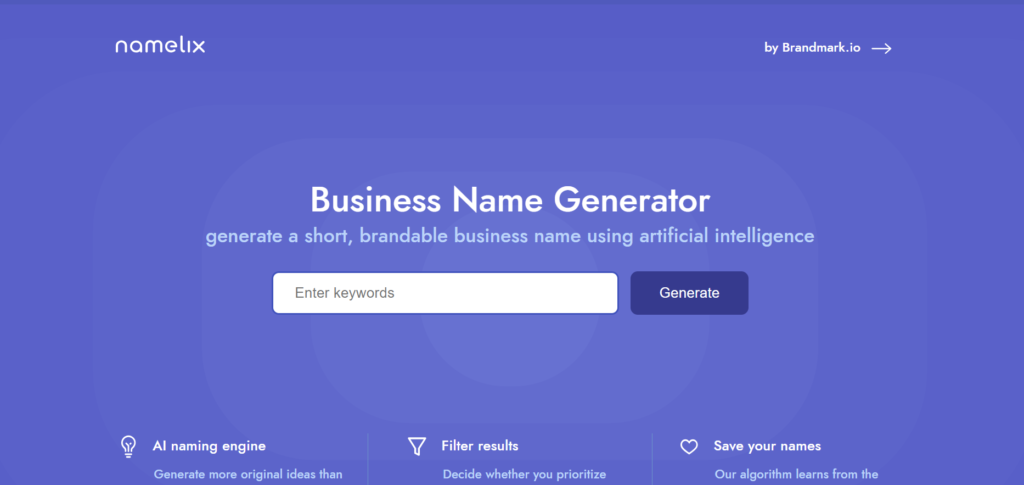
Namelix: Brandable Names with Instant Visual Identity
Namelix focuses on short, brandable names that function well as standalone identifiers. It prioritizes memorability and visual potential over literal description.
The platform asks for a few keywords, style preferences, and length constraints. It then generates dozens of options categorized by naming style: real words, modified words, compound words, and abstract blends. Each suggestion includes immediate domain availability checks across major extensions.
What separates Namelix is its integrated branding engine. Selecting a name automatically generates logo variations, color palettes, and typography pairings. This eliminates the disconnect between naming and visual identity. Founders can see how a name translates into a tangible brand asset before committing.
Real-World Application: A logistics startup used Namelix to find a name that conveyed speed without sounding generic. The AI suggested “Veloct” and “Runvia,” both unavailable as exact matches but available with modifier extensions. The team chose “Runvia,” secured the .com, and launched with a cohesive visual system generated in the same session.
Strengths:
- Strong focus on short, brandable names
- Real-time domain availability filtering
- Instant logo and brand asset generation
- Clean, intuitive interface
- Free basic access with premium upgrades
Limitations:
- Less effective for highly descriptive naming needs
- Abstract names may require additional marketing explanation
- Premium branding features require paid tier
Pricing: Free: Basic name generation. Premium: $20+ for full branding suite and domain purchase integration.
Official Site: https://namelix.com
Brandroot: Market-Ready Names with Premium Positioning
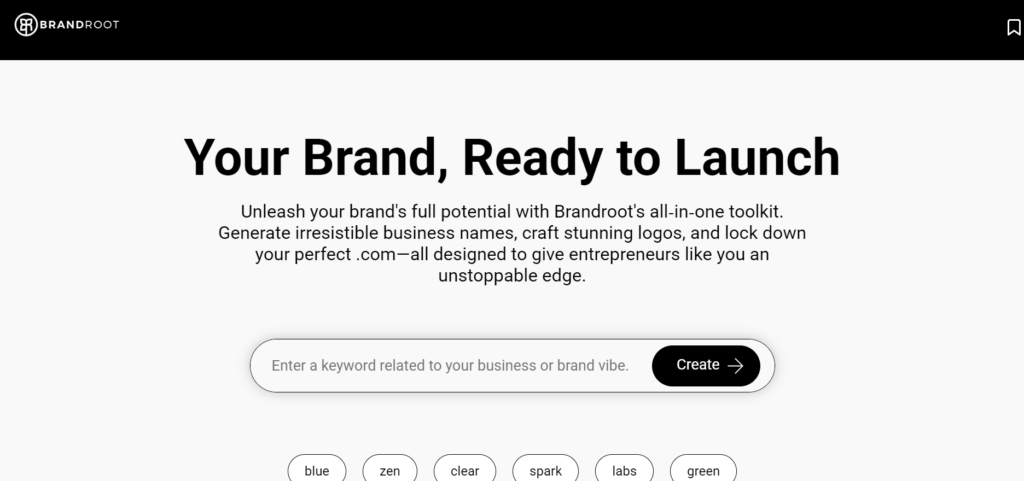
Brandroot operates differently from free generators. It curates premium, market-ready names that have already been vetted for commercial viability. The platform targets founders who want established credibility rather than experimental wordplay.
Each name in the Brandroot catalog comes with a registered .com domain, trademark clearance in relevant categories, and a pre-designed logo package. The AI matching system analyzes your industry, target audience, and brand values, then recommends names that align with those parameters. The suggestions lean toward professional, scalable identities suitable for venture-backed startups or established businesses rebranding.
Performance Reality: Brandroot excels when speed and legal safety matter more than creative experimentation. The names cost significantly more than DIY generators, but they eliminate months of trademark research and domain negotiation. Companies using Brandroot typically secure their digital footprint within 48 hours of selection.
Strengths:
- Pre-cleared trademark and domain packages
- Professional, scalable naming style
- Fast acquisition process
- Strong for B2B and enterprise positioning
- Comprehensive branding deliverables
Limitations:
- Higher price point ($2,500-$5,000+ per name)
- Less creative flexibility
- Catalog-driven rather than custom-generated
- Not ideal for budget-conscious founders
Pricing: Custom pricing per name package. Typically starts around $2,500.
Official Site: https://www.brandroot.com
Shopify Business Name Generator: E-Commerce Focused Discovery
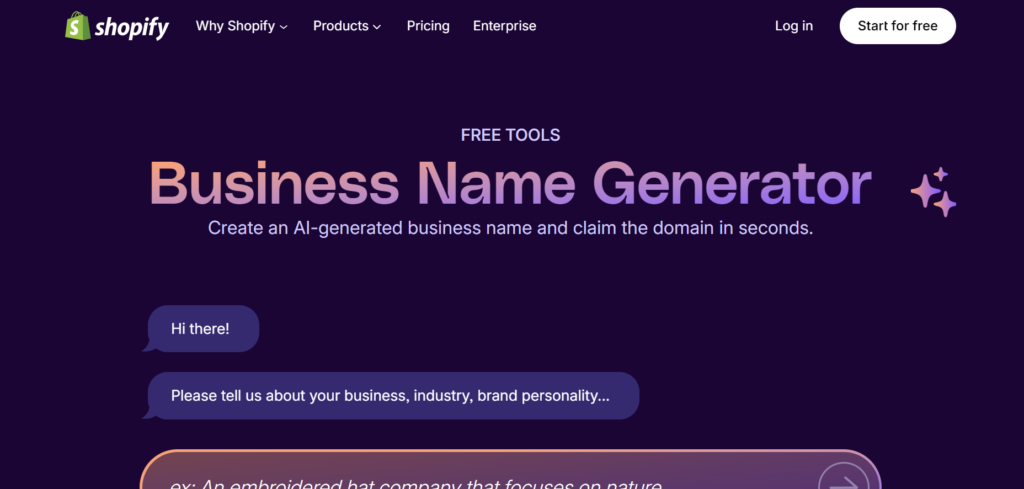
Shopify’s built-in naming tool serves merchants who need immediate, store-ready identities. It prioritizes clarity, searchability, and e-commerce compatibility over abstract branding.
The generator asks for a keyword and industry category. It returns available .com domains paired with matching business names. The AI filters out overly complex words, favoring clear, descriptive options that customers can easily spell and remember. It integrates directly with Shopify’s store setup, allowing founders to claim their name, register the domain, and launch a storefront in a single workflow.
Use Case Context: A handmade candle maker needed a name that communicated craftsmanship without sounding artisanal to the point of obscurity. The generator suggested “Wick & Craft,” “LumaHome,” and “EmberLine.” The founder selected “LumaHome,” secured the domain, and had a live store within three hours.
Strengths:
- Seamless e-commerce integration
- Focus on clear, customer-friendly names
- Instant domain registration
- Free to use
- Ideal for product-based businesses
Limitations:
- Limited creative range
- Less suitable for service or tech brands
- Basic filtering compared to specialized platforms
- No trademark verification
Pricing: Free.
Official Site: https://www.shopify.com/tools/business-name-generator
Squadhelp: Human-Curated AI Blends for Creative Brands
Squadhelp merges algorithmic generation with human creative direction. The platform runs naming contests where AI produces initial concepts, and professional naming experts refine the strongest options. This hybrid model appeals to brands that want creative depth without sacrificing efficiency.
You submit a creative brief outlining your audience, values, and naming preferences. The AI generates hundreds of options. Human curators filter for linguistic quality, cultural sensitivity, and brand alignment. The top candidates enter a community voting phase, where feedback helps identify the most resonant choices. The final selection includes trademark screening and domain availability verification.
Testing Observations: Squadhelp produces names with stronger emotional resonance than purely algorithmic tools. The human layer catches nuances that AI misses: regional slang conflicts, unintended double meanings, and industry-specific connotations. The process takes longer than instant generators, but the output typically requires less revision before legal filing.
Strengths:
- Human-AI hybrid quality control
- Strong creative direction
- Community feedback integration
- Comprehensive trademark screening
- Excellent for lifestyle and consumer brands
Limitations:
- Longer turnaround time (5-7 days)
- Higher cost than automated tools
- Contest format may feel less direct
- Not ideal for rapid MVP launches
Pricing: Starter: $99. Premium: $399. Elite: $799+.
Official Site: https://www.squadhelp.com
NameSnack: Bulk Generation with Domain Prioritization
NameSnack focuses on volume and speed. It generates thousands of name variations from a single keyword, then filters them by domain availability. The platform appeals to serial entrepreneurs, agency teams, and founders who want to secure multiple brand options before committing.
The AI applies linguistic transformations: prefixes, suffixes, vowel shifts, consonant swaps, and compound blends. It ranks results by memorability, pronunciation ease, and digital availability. The interface allows bulk exporting, making it easy to share shortlists with stakeholders or legal teams.
Workflow Application: A digital agency managing five client launches used NameSnack to generate 2,000 options per project in under an hour. The team filtered by industry relevance, checked trademark conflicts manually, and presented three vetted options per client. The bulk approach reduced naming research time by 70%.
Strengths:
- Massive generation volume
- Fast domain filtering
- Bulk export capabilities
- Simple, no-frills interface
- Good for agency and multi-brand workflows
Limitations:
- Quality varies across large batches
- Requires manual filtering for brand alignment
- Less sophisticated scoring than premium tools
- No integrated logo or branding features
Pricing: Free: Basic generation. Premium: $4.95/month for unlimited exports and advanced filters.
Official Site: https://namesnack.com
Lexii.ai: Context-Aware Naming Through Natural Language
Lexii.ai takes a conversational approach. Instead of keyword inputs, you describe your business in plain language. The AI parses your description, extracts core themes, and generates names that reflect your stated positioning, audience, and differentiators.
The platform emphasizes semantic accuracy over phonetic play. It understands context, industry jargon, and brand archetypes. If you describe a “privacy-focused email service for remote teams,” Lexii.ai avoids generic tech suffixes and suggests names that communicate security, simplicity, and collaboration.
Performance Notes: Lexii.ai excels at capturing nuance. It produces names that feel intentionally crafted rather than algorithmically assembled. The trade-off is slightly slower generation and fewer bulk options. The tool prioritizes quality over quantity, making it suitable for founders who want a name that tells a story.
Strengths:
- Context-aware generation
- Strong semantic accuracy
- Natural language input
- Good for mission-driven brands
- Clean, focused output
Limitations:
- Smaller output volume
- Less effective for abstract branding
- No integrated domain purchasing
- Limited trademark screening
Pricing: Free tier available. Pro: $12/month for advanced filtering and export.
Official Site: https://lexii.ai
Brandmark.io: Integrated Naming and Logo Ecosystem
Brandmark.io combines name generation with complete visual identity creation. The platform treats naming as the first step in a unified branding process. You input keywords and style preferences. The AI generates names, then immediately builds matching logos, color systems, and business card templates.
The naming algorithm prioritizes short, distinctive words that translate well into visual marks. It avoids overly descriptive names that limit brand expansion. Each suggestion includes domain availability, social handle checks, and a preview of how the name appears across digital and print media.
Implementation Reality: Brandmark.io works best for founders who want a turnkey brand launch. The integrated approach eliminates the friction of moving between naming tools, logo designers, and template platforms. The output feels cohesive because every element originates from the same algorithmic foundation.
Strengths:
- Complete naming-to-brand workflow
- Strong visual integration
- Fast turnaround
- Good for solopreneurs and small teams
- Affordable all-in-one pricing
Limitations:
- Less flexible for external design workflows
- Naming pool smaller than specialized tools
- Premium features require subscription
- Not ideal for enterprise rebranding
Pricing: Basic: $25. Premium: $65. Business: $165.
Official Site: https://brandmark.io
Strategic Selection: Matching Tools to Your Business Model
Not every platform serves every founder. Selection depends on your stage, budget, and brand positioning.
For Rapid MVP Launches: Shopify Business Name Generator or NameSnack Prioritize speed, domain availability, and e-commerce compatibility.
For Venture-Backed Startups: Brandroot or Squadhelp Invest in pre-cleared, scalable names that withstand legal scrutiny and investor review.
For Creative Consumer Brands: Namelix or Lexii.ai Focus on memorability, emotional resonance, and distinctive positioning.
For Complete Brand Launches: Brandmark.io Combine naming with immediate visual identity creation.
Evaluation Checklist:
- Does the tool filter by your industry and audience?
- Does it verify domain and social handle availability?
- Does it provide trademark screening or guidance?
- Can you export results for legal review?
- Does pricing align with your launch timeline and budget?
Test platforms with your actual keywords. Compare output quality, filtering accuracy, and workflow friction before committing.
Validation Framework: From Generated List to Registered Trademark
Generating names is only the first step. Validation determines commercial viability. Follow this structured process to avoid costly mistakes.
Phase 1: Linguistic Screening
- Pronounce the name aloud. Does it stumble or flow?
- Spell it for a friend. Do they get it right on the first try?
- Search the name globally. Does it carry unintended meanings in other languages?
- Check for negative associations in your target markets.
Phase 2: Digital Availability
- Verify .com availability. If taken, assess aftermarket cost.
- Check major social platforms: Instagram, X, LinkedIn, TikTok.
- Test email deliverability. Does the name create confusing addresses?
- Run a reverse image search to ensure no existing brand uses identical visuals.
Phase 3: Legal Clearance
- Search USPTO (or your country’s trademark database) for identical or confusingly similar marks.
- Check state business registries for corporate name conflicts.
- Consult a trademark attorney for high-stakes launches.
- File intent-to-use applications early to secure priority dates.
Phase 4: Market Testing
- Share top 3 options with target audience segments.
- Measure recall after 24 hours.
- Track preference across demographics.
- Select the name with strongest resonance and lowest friction.
Automation accelerates generation. Human judgment ensures longevity. Never skip validation.
Common Naming Traps That Derail Launches
Even sophisticated platforms produce flawed results when misapplied. Avoid these critical errors.
1. Chasing Trends Over Timelessness Names built around current slang, meme culture, or tech suffixes age quickly. Aim for clarity and durability. Trends fade. Strong names endure.
2. Overcomplicating for Uniqueness Inventing unpronounceable words sacrifices recall for originality. If customers cannot spell or say your name, they cannot refer you. Simplicity scales.
3. Ignoring Trademark Reality Availability does not equal clearance. A domain may be free while a trademark blocks your category. Always verify legal viability before investing in branding.
4. Prioritizing the Founder Over the Customer Names that reflect internal inside jokes or technical jargon alienate external audiences. Test with your actual market, not your inner circle.
5. Skipping Social Handle Consistency Fragmented handles create confusion and enable impersonation. Secure matching usernames across platforms before announcing your brand.
6. Assuming AI Replaces Strategy Algorithms generate options. Humans define direction. Use AI to expand possibilities, not to dictate brand positioning. Align every suggestion with your long-term vision.
Frequently Asked Questions
Do AI business name generators guarantee trademark clearance?
No. They check availability against public databases, but trademark law involves nuanced classification and geographic considerations. Always consult a qualified attorney before filing. AI accelerates discovery. Legal professionals ensure protection.
Can I use generated names for registered businesses?
Yes. Once you verify availability and secure rights, generated names function identically to manually created ones. Ownership transfers to you upon registration. The creation method does not affect legal standing.
How much do AI naming tools cost?
Free platforms offer basic generation and limited exports. Premium tools range from $5 to $20 monthly for unlimited access. Enterprise or curated services cost $100 to $5,000+ depending on legal screening and branding packages. Budget aligns with launch complexity.
Should I prioritize the .com extension?
Historically, yes. The .com remains the most trusted and memorable extension. However, modern consumers accept .io, .co, .ai, and industry-specific extensions when the name is strong. Secure the .com if possible, but do not sacrifice a perfect name for an imperfect extension.
How long does the naming process take with AI?
Generation happens in seconds. Validation requires 3-7 days for linguistic checks, digital availability, and trademark research. Market testing adds another 5-10 days. Total timeline: 1-3 weeks from blank slate to registered brand.
Can AI generators handle non-English markets?
Yes, but accuracy varies. Leading platforms support multiple languages, yet cultural nuance and regional trademark databases require manual verification. Always test names with native speakers and local legal counsel before international expansion.
What if my preferred name is taken?
Modifiers work effectively: add location, verb, or descriptor prefixes. Alternatively, explore alternative extensions or negotiate domain purchases. Sometimes a slight variation strengthens brand distinctiveness. Flexibility accelerates launch.
Do investors care how the name was generated?
No. Investors evaluate market fit, traction, and team execution. A strong name supports positioning, but the creation method carries no weight. Focus on clarity, availability, and strategic alignment. Execution matters more than origin.