
AI research tools have transformed how scholars, professionals, and curious minds process complex information. Reading every academic paper, technical report, or industry study in full is no longer practical—or necessary. Intelligent platforms now extract core arguments, identify methodological strengths, and surface actionable insights in minutes rather than hours.
If you are still highlighting PDFs manually, copying quotes into scattered notes, and struggling to connect findings across dozens of sources, you are working harder than you need to. Modern systems do not just summarize text. They understand context, evaluate credibility, and organize knowledge in ways that accelerate decision-making and discovery.
This guide examines seven platforms that lead the research intelligence space in 2026. We focus on practical workflows, accuracy benchmarks, and integration strategies—helping you choose tools that genuinely enhance your thinking rather than simply automating busywork.
- The Information Overload Problem
- How AI research tools Actually Process Complex Content
- Consensus: Evidence-Based Answers from Scientific Literature
- Elicit: Research Assistant for Literature Reviews
- Scite.ai: Smart Citations That Show Context and Credibility
- ScholarAI: Conversational Access to Academic Databases
- Paperpal: Writing Support with Research Intelligence
- ResearchRabbit: Visual Discovery and Connection Mapping
- Connected Papers: Graph-Based Literature Exploration
- Choosing the Right Tool for Your Research Style
- Best Practices for AI-Assisted Knowledge Work
- Common Pitfalls That Compromise Research Quality
- Frequently Asked Questions
The Information Overload Problem
Researchers face an impossible volume of content. Over 4 million academic papers publish annually. Industry reports, preprints, conference proceedings, and technical documentation multiply that figure exponentially. No human can read comprehensively across even a narrow specialty.
Traditional approaches—keyword searches, manual screening, linear note-taking—scale poorly. Important findings get buried. Contradictory evidence goes unnoticed. Synthesis becomes the bottleneck rather than insight generation.
AI research tools address this structural challenge. They ingest thousands of documents, identify patterns across studies, flag methodological concerns, and present distilled conclusions with source attribution. The goal is not to replace critical thinking. It is to free cognitive capacity for higher-order analysis: interpretation, application, and innovation.
How AI research tools Actually Process Complex Content
Understanding the mechanics prevents misuse and sets realistic expectations. These systems do not “read” like humans. They apply layered computational techniques to extract meaning efficiently.
Semantic Parsing Natural language models identify claims, evidence, methods, and conclusions within dense academic prose. They distinguish between hypothesis and finding, correlation and causation, limitation and strength.
Citation Network Analysis Algorithms map how papers reference one another, revealing influential works, emerging consensus, and scholarly disputes. This contextual layer helps prioritize which sources deserve deeper attention.
Cross-Document Synthesis Advanced platforms compare findings across multiple studies, identifying agreements, contradictions, and research gaps. They generate narrative summaries that preserve nuance while reducing length.
Credibility Scoring Some tools evaluate journal reputation, author credentials, sample sizes, and statistical rigor to flag potentially unreliable conclusions. This helps users weigh evidence appropriately.
The output is not a replacement for reading. It is a structured entry point that guides efficient, informed engagement with primary sources.
“If you plan to share your research findings through audio content, optimizing your production workflow is essential. Our guide on AI tools for podcasters shows you how to automate editing, enhance audio quality, and distribute episodes efficiently—turning complex insights into engaging conversations.”
Consensus: Evidence-Based Answers from Scientific Literature
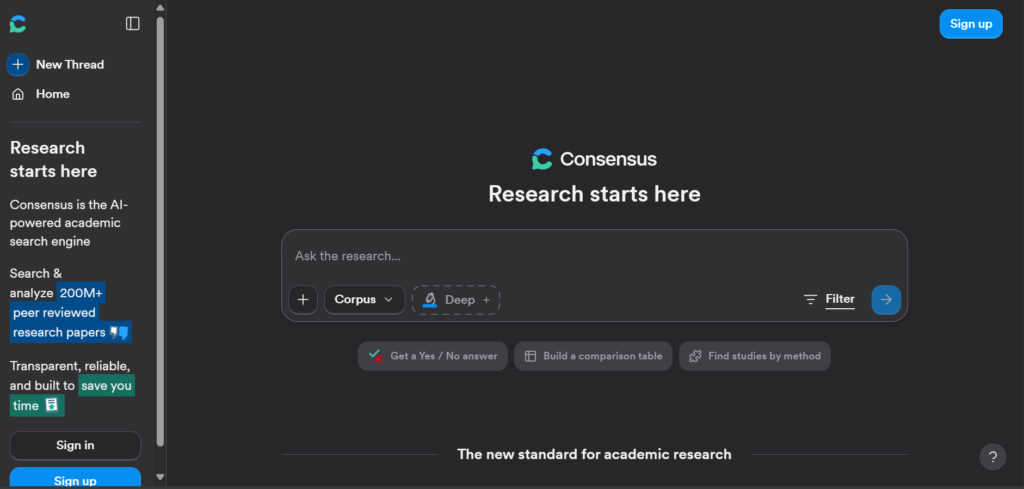
Consensus operates as a search engine for scientific knowledge. You ask a question in plain language, and the system returns answers grounded in peer-reviewed research, with direct citations and confidence indicators.
Core Workflow: Type “Does intermittent fasting improve metabolic health?” Consensus scans thousands of studies, extracts relevant findings, and presents a synthesized answer with links to source papers. Each claim includes a “Consensus Meter” showing the proportion of studies supporting, contradicting, or remaining neutral on the claim.
Strengths:
- Direct answers with source attribution
- Consensus visualization for contested topics
- Focus on peer-reviewed literature
- Clean, intuitive interface
- Free tier with generous usage
Limitations:
- Primarily biomedical and life sciences focus
- Less effective for emerging fields with limited literature
- Summaries may oversimplify complex methodological debates
Pricing: Free: Basic searches. Pro: $10/month for advanced filters and export.
Official Site: https://consensus.app
Elicit: Research Assistant for Literature Reviews
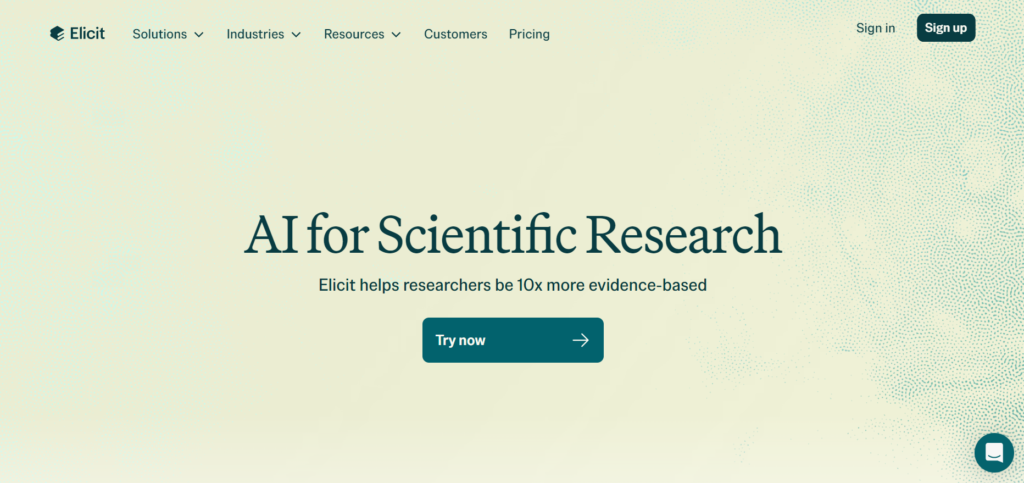
Elicit specializes in accelerating literature reviews and systematic research projects. It helps you find relevant papers, extract key data points, and organize findings thematically.
Key Capabilities: Upload a research question or upload PDFs directly. Elicit identifies relevant papers from Semantic Scholar, extracts abstracts and conclusions, and allows you to filter by methodology, sample size, or publication date. The AI can answer specific questions across multiple papers simultaneously: “What were the inclusion criteria?” or “What effect sizes were reported?”
Real-World Application: A public health researcher used Elicit to screen 200+ papers on vaccine hesitancy interventions. The tool extracted study designs, populations, and outcomes into a structured table, reducing manual screening time from 40 hours to 6 hours.
Strengths:
- Excellent for systematic reviews and meta-analyses
- Bulk PDF processing and data extraction
- Customizable filtering and export options
- Strong academic database integration
- Active development and feature updates
Limitations:
- Learning curve for advanced features
- Occasional extraction errors requiring manual verification
- Free tier limited to 50 queries/month
Pricing: Free: 50 queries/month. Researcher: $10/month. Team: Custom pricing.
Official Site: https://elicit.com
Scite.ai: Smart Citations That Show Context and Credibility
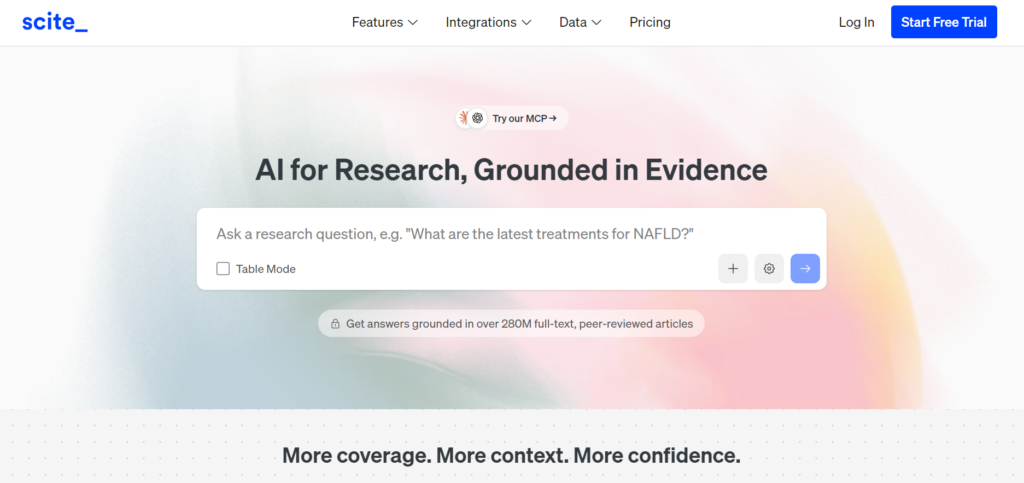
Scite.ai reimagines citation analysis by showing not just that a paper was cited, but how it was cited: as supporting evidence, as a contrasting finding, or merely as a mention.
How It Works: When you view a paper in Scite, citation statements appear with classification labels. You can filter to see only studies that support or contradict a claim. The “Smart Citation” feature highlights whether subsequent research has validated or challenged the original findings.
Use Case: A policy analyst evaluating a controversial intervention used Scite to identify which subsequent studies confirmed the original results and which raised methodological concerns. This contextual layer prevented overreliance on a single influential paper.
Strengths:
- Unique citation context classification
- Helps identify contested or debunked findings
- Browser extension for seamless integration
- Strong for evidence-based decision making
- Good academic coverage
Limitations:
- Coverage less comprehensive than Google Scholar
- Classification accuracy varies by field
- Premium features required for full access
Pricing: Free: Limited searches. Individual: $5/month. Institutional: Custom pricing.
Official Site: https://scite.ai
ScholarAI: Conversational Access to Academic Databases
ScholarAI provides a chat interface for querying academic literature. Instead of keyword searches, you ask questions conversationally and receive synthesized answers with citations.
Functionality: Ask “What are the main criticisms of cognitive behavioral therapy for anxiety?” ScholarAI retrieves relevant papers, extracts key arguments, and presents a balanced summary with source links. Follow-up questions refine the response without restarting the search.
Performance Notes: The conversational approach excels at exploratory research and initial topic familiarization. It is less suited for exhaustive systematic reviews but ideal for rapid orientation to new fields.
Strengths:
- Natural language query interface
- Good for exploratory research
- Fast answer generation
- Citation transparency
- Free access with registration
Limitations:
- Less control over search parameters
- Summaries may miss nuanced methodological details
- Coverage depends on underlying database
Pricing: Free with registration. Premium features in development.
Official Site: https://scholarai.net

Paperpal: Writing Support with Research Intelligence
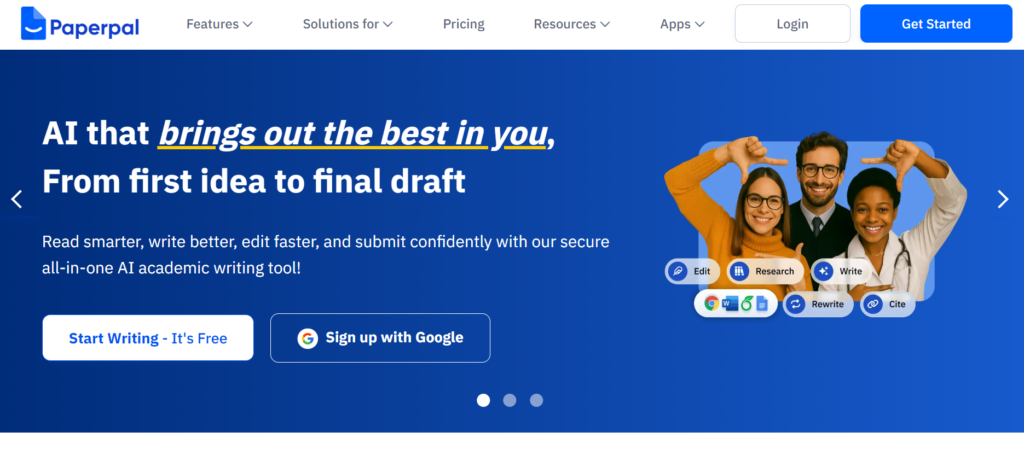
Paperpal focuses on academic writing assistance, but its research intelligence features help authors engage more effectively with source material during the writing process.
Research Features: While drafting, Paperpal suggests relevant citations based on your text, flags claims that need supporting evidence, and identifies potential contradictions with established literature. The AI can summarize referenced papers to help you accurately represent their findings.
Application: A graduate student writing a thesis used Paperpal to ensure each literature review paragraph accurately reflected source studies. The tool flagged overgeneralizations and suggested additional citations to strengthen arguments.
Strengths:
- Integrated writing and research support
- Real-time citation suggestions
- Helps maintain academic integrity
- Good for non-native English writers
- Journal-specific style guidance
Limitations:
- Primarily designed for writing phase, not discovery
- Less powerful for large-scale literature synthesis
- Subscription required for full features
Pricing: Free: Basic checks. Premium: $12/month for full research intelligence.
Official Site: https://paperpal.com
ResearchRabbit: Visual Discovery and Connection Mapping
ResearchRabbit uses network visualization to help you explore literature connections intuitively. Add a seed paper, and the system builds an interactive graph of related works, authors, and concepts.
Visual Workflow: The graph shows citation relationships, co-authorship networks, and thematic clusters. You can filter by date, journal, or methodology. Clicking any node reveals abstracts and key findings without leaving the visualization.
Use Case: A doctoral candidate mapping the evolution of a theoretical framework used ResearchRabbit to identify foundational papers, key critics, and emerging applications. The visual approach revealed connections missed by linear search methods.
Strengths:
- Intuitive visual exploration
- Excellent for understanding field structure
- Collaborative collections for team research
- Free with no usage limits
- Regular feature updates
Limitations:
- Less effective for precise factual queries
- Visual complexity can overwhelm beginners
- Primarily computer science and social sciences coverage
Pricing: Free.
Official Site: https://www.researchrabbitapp.com

Connected Papers: Graph-Based Literature Exploration
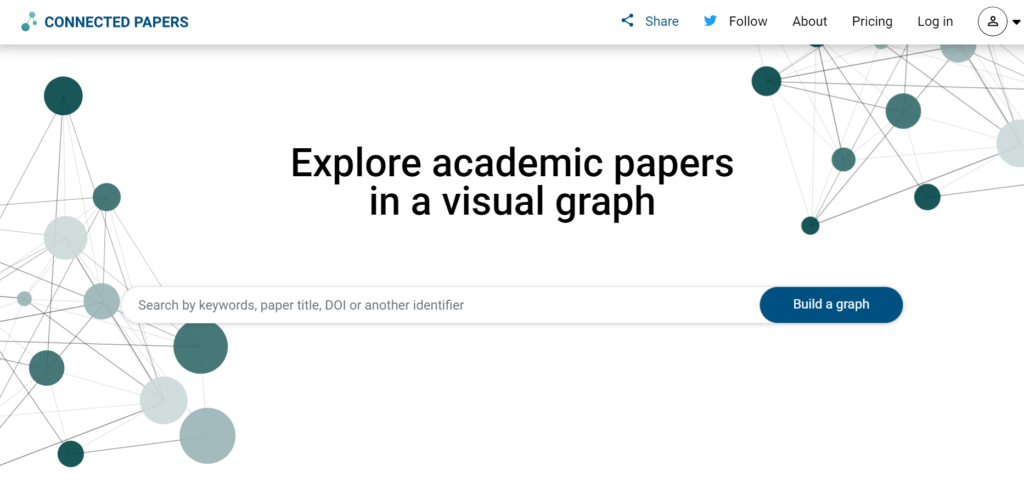
Connected Papers generates bibliographic graphs that show how research evolves over time. Enter a paper, and the system displays a visual map of prior work it builds upon and subsequent studies it influenced.
Graph Intelligence: The visualization uses similarity algorithms, not just citation counts, to identify conceptually related work. This helps discover influential papers that may not be heavily cited but shaped the field’s direction.
Performance: Connected Papers excels at historical tracing and identifying seminal works. It is less suited for answering specific factual questions but invaluable for understanding intellectual lineage.
Strengths:
- Clear visual representation of research evolution
- Identifies foundational and derivative works
- Fast graph generation
- Free for basic use
- Good for literature review preparation
Limitations:
- Limited to graph exploration (no Q&A)
- Less comprehensive than dedicated search engines
- Premium required for advanced filters
Pricing: Free: Basic graphs. Pro: $6/month for unlimited graphs and exports.
Official Site: https://www.connectedpapers.com
Choosing the Right Tool for Your Research Style
Not every platform serves every researcher. Selection depends on your workflow, discipline, and objectives.
For Evidence-Based Decision Making: Consensus or Scite.ai Prioritize verified findings and citation context.
For Systematic Reviews: Elicit or Paperpal Focus on bulk extraction, data organization, and writing support.
For Exploratory Discovery: ScholarAI or ResearchRabbit Emphasize conversational querying and visual connection mapping.
For Understanding Field Evolution: Connected Papers Trace intellectual lineage and identify seminal works.
Evaluation Checklist:
- Does the tool cover your discipline adequately?
- Does it provide source attribution for all claims?
- Can you export results for further analysis?
- Does pricing align with your usage frequency?
- Does it integrate with your existing workflow?
Test platforms with actual research questions before committing. Measure time saved, accuracy maintained, and insight quality gained.
Best Practices for AI-Assisted Knowledge Work
AI research tools amplify capability but require disciplined use to maintain rigor.
1. Treat Summaries as Entry Points Always verify key claims against original sources. AI can misinterpret nuance, overlook limitations, or oversimplify complex findings.
2. Cross-Reference Multiple Tools Different platforms use different databases and algorithms. Comparing outputs reveals consensus and flags potential biases.
3. Document Your Process Record which tools you used, search parameters, and filtering criteria. This transparency supports reproducibility and peer review.
4. Maintain Critical Distance AI suggestions are starting points, not conclusions. Apply your expertise to evaluate methodology, context, and applicability.
5. Update Regularly Research evolves rapidly. Re-run queries periodically to capture new findings that may change earlier conclusions.
Common Pitfalls That Compromise Research Quality
1. Over-Reliance on Summaries Reading only AI-generated abstracts misses methodological details, contextual limitations, and author intent. Use summaries to prioritize, not replace, deep reading.
2. Ignoring Publication Bias AI tools surface available literature, but negative results and replication failures are underrepresented in academic publishing. Actively seek contradictory evidence.
3. Confusing Correlation with Causation Automated extraction may present associations as causal claims. Apply critical thinking to interpret relationships appropriately.
4. Neglecting Source Quality Not all papers are equally rigorous. Use journal reputation, citation metrics, and methodological transparency to weight evidence.
5. Skipping Contextual Understanding Findings apply to specific populations, settings, and time periods. AI may generalize beyond appropriate boundaries. Always consider applicability to your context.
Frequently Asked Questions
Do AI research tools replace reading original papers?
No. They accelerate discovery and prioritization. Critical analysis, methodological evaluation, and contextual interpretation still require human engagement with primary sources.
How accurate are AI-generated summaries?
Leading platforms achieve 85-95% accuracy on factual extraction. However, nuance, tone, and methodological critique require human judgment. Always verify high-stakes claims.
Can these tools access paywalled content?
Most tools index open-access abstracts and metadata. Full-text access depends on your institutional subscriptions. Some platforms partner with publishers for expanded access.
Are AI research tools suitable for systematic reviews?
Yes, with caveats. Tools like Elicit excel at screening and data extraction. However, protocol registration, risk-of-bias assessment, and final synthesis still require researcher oversight.
Do these platforms work across all academic disciplines?
Coverage varies. Biomedical and life sciences have the most comprehensive support. Social sciences, humanities, and emerging fields may have sparser coverage. Verify discipline-specific performance before relying heavily.
How do I cite AI-generated summaries in academic work?
Cite the original source papers, not the AI tool. If you reference the tool’s functionality (e.g., “screened using Elicit”), mention it in methods with version information.
Can AI research tools help with non-English literature?
Support is improving but limited. Major platforms prioritize English-language publications. For multilingual research, combine AI tools with human translation and regional database searches.
What about data privacy with uploaded documents?
Reputable platforms encrypt uploads, process data securely, and delete files after analysis. Review privacy policies carefully, especially for unpublished or sensitive research.